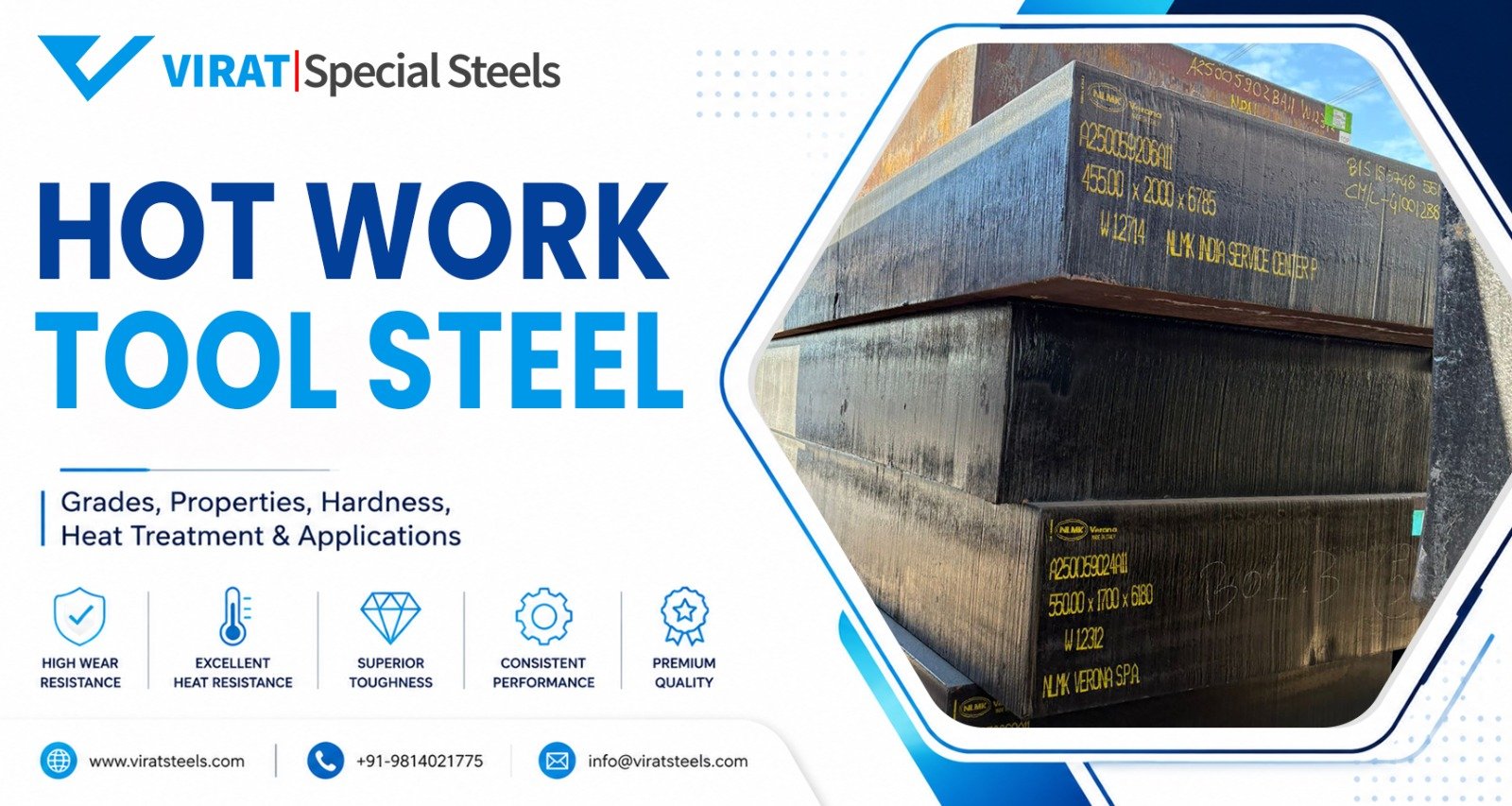
Hot work tool steel is designed for one purpose – to resist heat that would ruin common steel. It is the material behind the dies, molds, punches and blades that are hammered and squeezed and repeatedly heated and cooled – in die casting, forging, extrusion, hot stamping and hot shearing.
And what makes it different is easy to say and hard to engineer. It keeps its hardness, toughness, strength and dimensional stability, even when it’s hot. The most common grades you’ll come across are H13 (DIN 1.2344), H11 (DIN 1.2343) and DB6 (DIN 1.2714) — which one you need depends on your operating temperature, impact load, die size and how long you want the tool to last.
What Is Hot Work Tool Steel?
It’s an alloy tool steel for tools that get hot and cycle between hot and cold, again and again. It must be a combination of hot hardness, toughness, wear resistance, thermal-fatigue resistance and dimensional stability — all at the same time.
The Three Grades You Should Know:
- H13 / DIN 1.2344 – the go-to grade for die casting, aluminum extrusion and hot forging.
- H11 / DIN 1.2343 — good balance of toughness and hot strength, for forging and extrusion.
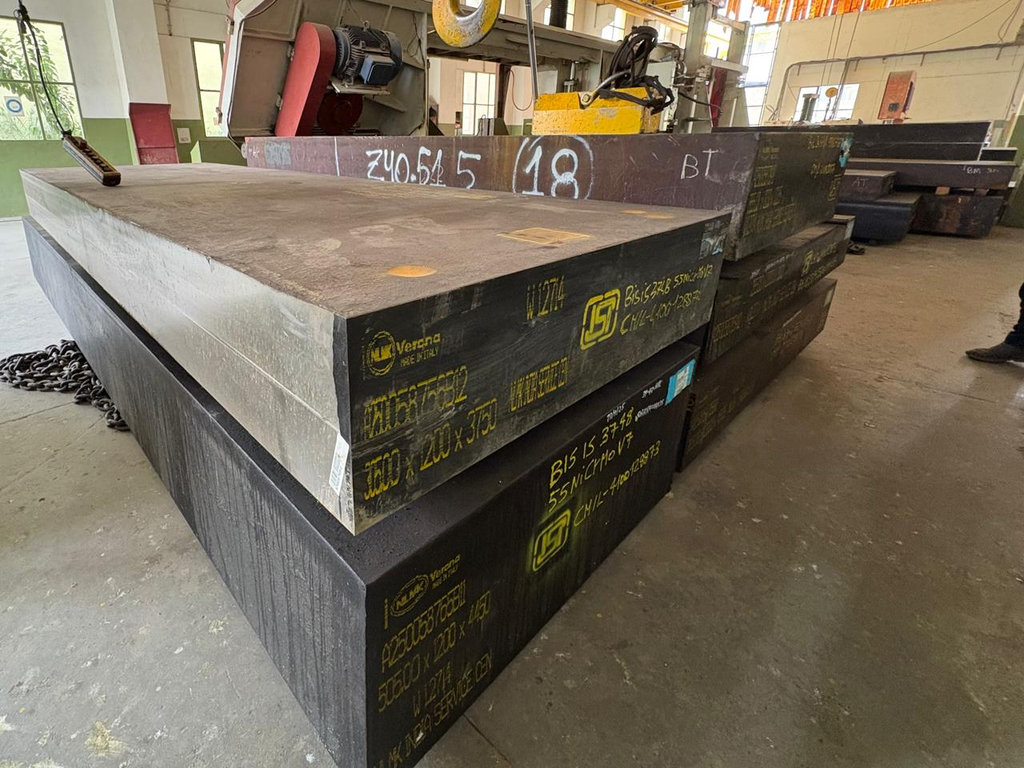
- DB6 / DIN 1.2714 – the choice for large forging dies, hammer dies and heavy-impact work where toughness is the most important property.
The final choice should always be based on the application and the steel maker’s datasheet, not on a general guide like this.
Hot work tool steel is a high-alloy steel for tooling operating at temperatures above about 200°C. Hot work grades are designed to resist the direct action of molten metal and hot workpieces, as opposed to cold-work steels, which are designed for cutting and forming at room temperature.
You will find it in aluminum and brass die-casting dies, forging dies, extrusion dies, hot shear blades, punches, mandrels, hot trimming dies, glass molds and copper alloy dies. It is their resistance to heat checking, deformation and softening that keeps these tools dimensionally stable and working reliably, cycle after cycle.
Popular Hot Work Tool Steel Grades
| Steel Grade | DIN Standard | Equivalent | Common Applications |
| H13 | 1.2344 | AISI H13 / JIS SKD61 | Die casting, forging, aluminium extrusion |
| H11 | 1.2343 | AISI H11 / JIS SKD6 | Forging dies, aluminium dies, extrusion |
| DB6 | 1.2714 | No exact AISI match; closest reference ~L6 | Hammer dies, press dies, forging dies |
| H21 | 1.2581 | AISI H21 | High-temperature tooling |
| H10 | 1.2365 | AISI H10 | Hot-work applications |
| H12 | 1.2606 | AISI H12 | Hot-work applications |
Mechanical Properties
| Property | H13 | DB6 |
| Density | 7.75–7.85 g/cm³ | 7.70–7.85 g/cm³ |
| Tensile Strength | 1550–2100 MPa | High |
| Hardness | 44–54 HRC | 38–42 HRC (working); refer to supplier datasheet |
| Toughness | Excellent | Excellent |
| Wear Resistance | Excellent | Excellent |
| Thermal Fatigue Resistance | Excellent | Excellent |
Chemical Composition
The alloying elements are what actually give hot work tool steel its personality — hardness, toughness, wear resistance and how it behaves under heat.
| Element | H13 (%) | DB6 (%) |
| Carbon (C) | 0.32–0.45 | 0.50–0.60 |
| Silicon (Si) | 0.80–1.25 | 0.10–0.40 |
| Manganese (Mn) | 0.20–0.60 | 0.65–0.95 |
| Chromium (Cr) | 4.75–5.50 | 1.00–1.20 |
| Molybdenum (Mo) | 1.10–1.75 | 0.45–0.55 |
| Vanadium (V) | 0.80–1.20 | 0.07–0.12 |
| Nickel (Ni) | — | 1.50–1.80 |
Hardness (HRC Scale)
Hardness is usually the first thing buyers ask about and it is really a trade-off push hardness up and you get wear resistance but you risk giving up toughness and a tool that is too hard cracks before it wears out.
| Grade | Typical Working Hardness |
| H13 | 44–54 HRC |
| H11 | 42–50 HRC |
| DB6 (1.2714) | 38–42 HRC |
DB6 is designed for lower working hardness than H13 tool steels – it is selected for hammer and large forging dies because it sacrifices some wear resistance for superior toughness, so it is tempered back further to prevent cracking under heavy impact.
Tip: The right hardness is not the hardest, it is the one that works for your application and duty cycle. Always verify the exact range with the datasheet of your supplier, as this may differ with section size and delivery condition.
How Hot Work Tool Steel Is Made
Good performance from hot work tool steel is not just a matter of choosing the right grade on paper – it is a matter of how well the steel was melted, forged, heat treated and inspected along the way.
1. Raw Material Selection
Everything starts with the alloying mix, and each element earns its place:
| Element | Main Function |
| Carbon | Hardness and strength |
| Chromium | Wear resistance and hardenability |
| Molybdenum | High-temperature strength |
| Vanadium | Grain refinement and wear resistance |
| Nickel | Toughness |
| Silicon | Strength and heat resistance |
| Manganese | Strength and hardenability |
2. Smelting & Refining
The steel is melted in an Electric Arc Furnace (EAF) and then further refined to the desired chemistry and cleanliness.
Ladle refining improves alloy composition, controls temperature and reduces contamination
Vacuum degassing removes dissolved gasses, mainly hydrogen, leading to better toughness, improved fatigue life, fewer internal defects and a more reliable material overall.
3. Electro-Slag Remelting (ESR)
ESR is a must when cleanliness and consistency counts. It provides a more homogeneous microstructure, better toughness and fatigue life, less segregation and a significantly improved polishability – which is why ESR grades are found in precision dies, high pressure die casting and plastic molds.
4. VAR (Vacuum Arc Remelting)
For the most demanding applications VAR takes purity one step further – lower inclusion levels, more uniform microstructure and better fatigue resistance.
5. Ingots casting
Molten steel is poured into ingots before forging, under controlled solidification conditions to minimize segregation and shrinkage.
6. Forging
Forging turns the cast ingot into dense blocks and bars by controlled heating and deformation. It increases the toughness, the grain structure, the internal flaws and gives more consistent mechanical properties to the material. Typical outputs are forged blocks, die blocks, round bars, flat bars and ESR blocks.
7. Annealing
Annealing is the process that softens the steel for machining and preparation for hardening — heat, soak evenly, then cool in a controlled fashion.
| Grade | Approx. Annealed Hardness |
| H13 | 190–230 HB |
| H11 | 180–230 HB |
| DB6 (1.2714) | 255 HB max |
Hardening is the method by which steel is given strength and wear resistance. It involves controlled pre-heating, austenitising, soaking and controlled cooling or quenching.
| Grade | Typical Austenitizing Range |
| H13 | 1,020–1,050°C |
| H11 | 1,000–1,030°C |
| DB6 (1.2714) | ~850–900°C (typical for this Ni-Cr-Mo grade; noticeably lower than the Cr-Mo-V H-series) |
DB6 is a lower alloy nickel chromium molybdenum steel and hardens at a substantially lower temperature than H13 or H11. Always stick to the manufacturer’s datasheet for the exact cycle – especially if you are working with large sections where getting this wrong is expensive.
9. Tempering
Tempering is done after hardening to reduce brittleness and to obtain the final balance between hardness and toughness. It relieves residual stress, increases toughness and helps dimensional stability. Depending on the grade, multiple cycles of tempering may be utilized.
Heat Treatment at a Glance
| Stage | Purpose |
| Annealing | Improve machinability |
| Stress Relieving | Reduce machining stresses |
| Hardening | Increase hardness and strength |
| Tempering | Improve toughness and stability |
| Final Inspection | Verify required properties |
10. Quality Inspection
The material is examined from every point of view before being shipped:
Ultrasonic Testing (UT) — identifies internal cracks, inclusions, laminations and shrinkage-related defects, especially important on large forged blocks.
Chemical composition testing – a spectrometer tests carbon, chromium, molybdenum, vanadium, nickel, silicon, manganese, sulfur and phosphorus against the specified grade.
Hardness and dimensional inspection: Rockwell or Brinell testing, checks of length, width, thickness, flatness, squareness, straightness and surface finish.
11. MTC (Material Test Certificate)
An MTC links grade, heat number, chemical composition, mechanical properties, hardness, heat-treatment condition, inspection results and manufacturer details. It provides buyers with a paper trail they can verify.
| Document / Test | Purpose |
| MTC / EN 10204 3.1 | Material traceability and test results |
| UT Report | Internal quality verification |
| Spectrometer Report | Chemical composition |
| Hardness Report | Hardness verification |
| Heat Number | Batch traceability |
| Dimensional Report | Size verification |
Where Hot Work Tool Steel Is Used
Aluminum diecast molds H13 tool steel is the material of choice here because it can be repeatedly heated and cooled without losing dimensional stability – think engine blocks, gear housings, transmission components, pump bodies, LED housings and other automotive parts.
Hot-forging dies They are pounded by impact loads and heat, which is why DB6 and H11—valued for toughness and resistance to thermal cracking—are the usual choices. Common on crankshafts, connecting rods, railroad components and heavy engineering components.
Extrusion Dies High hot strength and wear resistance is needed to keep profiles – used for aluminum profiles, window frames, heat sinks and electrical conductors.
Brass and copper die cast. These alloys run hotter than aluminum so H13 and H11 earn their keep with better hot hardness.
Hot shear blades, for cutting red-hot blooms, billets and bars in rolling mills;
Hot punches, made for hot piercing, making and punching where wear and impact resistance both count.
Glass molds on the basis of thermal stability and resistance to heat checking.
Plastic mold parts: ESR H13 material tool preferred for polishability and wear resistance.
Industries That Rely on It
| Industry | Applications |
| Automotive | Die casting, forging |
| Aerospace | Forging tools |
| Defence | Heavy-duty dies |
| Railways | Forged components |
| Aluminium | Extrusion dies |
| Plastic Moulding | Mould inserts |
| Steel Plants | Hot shear blades |
| Heavy Engineering | Forging tools |
| Energy | Turbine & valve tooling |
Hot Work vs. Cold Work vs. Plastic Mould Steel
| Feature | Hot Work Tool Steel | Cold Work Tool Steel | Plastic Mould Steel |
| Primary Use | High-temperature tooling | Room-temperature cutting/forming | Plastic injection & moulding |
| Operating Temperature | High | Low to moderate | Low to moderate |
| Key Property | Hot hardness & thermal fatigue resistance | Wear resistance & hardness | Toughness, polishability & machinability |
| Important Grades | H13, H11, DB6 | D2, D3, EN31 | P20, P20+Ni, 1.2083 |
| Common Applications | Die casting, forging, extrusion | Dies, punches, blanking, shear blades | Injection moulds, plastic moulds |
| Typical Hardness | 44–54 HRC | 55–62 HRC | 28–52 HRC |
| Main Advantage | Retains strength at elevated temperatures | Excellent wear & edge retention | Good machinability and surface finish |
| Typical Industries | Automotive, forging, die casting | Tool & die, automotive, engineering | Plastic, packaging, automotive |
| Parameter | H13 | DB6 |
| Type | Chromium hot work steel | Nickel-chromium-molybdenum tool steel |
| Hardness | 44–54 HRC | 38–42 HRC |
| Toughness | Excellent | Outstanding |
| Wear Resistance | Higher | Moderate |
| Thermal Fatigue | Excellent | Very good |
| Large Dies | Good | Excellent |
| Forging Applications | Very good | Excellent |
| Impact Resistance | Good | Superior |
| Aluminium Die Casting | Excellent | Good |
H13/DB6 comparison table in die casting and extrusion; go with DB6 for large forging dies, hammer dies and heavy-impact work.
Advantages & Limitations
| Advantages | Limitations |
| Excellent hot hardness | Higher material cost |
| High thermal fatigue resistance | Needs proper heat treatment |
| Excellent toughness | Harder to machine once hardened |
| Good wear resistance | Limited corrosion resistance |
| Good machinability when annealed | Large sections need controlled processing |
| Excellent dimensional stability | |
| Long tool life |
How to Choose the Right Grade
1. Match the grade to the application.
| Application | Recommended Grade |
| Aluminium die casting | H13 (1.2344) |
| Brass die casting | H13 |
| Hot forging dies | H11 (1.2343) |
| Hammer dies | DB6 (1.2714) |
| Extrusion dies | H13 |
| Plastic mould inserts | ESR H13 |
| Large forging blocks | DB6 |
Get the size right. Think about how long it’s how wide it is, how thick it is, Think about length, width, thickness, weight, machining allowance, and expected dimensional change during heat treatment.. Available forms include forged blocks, round bars, flat bars, ESR blocks and pieces that are already cut to size.
Settle on a delivery condition with your supplier — annealed, pre-hardened, hardened and tempered, soft annealed, or stress relieved. With your supplier.
Check the quality before you make a decision. Ask for testing results, spectrometer reports, material test certificates, heat-number traceability and confirmation of surface finish, straightness and mechanical properties.
Plan the amounts you need based on prototypes, regular production, yearly use, extra stock and any growth that is coming up.
Choose a supplier who can support you. One that has stock, imported materials, forged and ESR blocks, fast delivery, technical help, certificates and custom machining.
Certifications Worth Looking For
| Certification | Purpose |
| ISO 9001 | Quality management system |
| EN 10204 3.1 | Material test certificate |
| Ultrasonic Testing (UT) | Detects internal defects |
| Spectrometer Analysis | Verifies chemical composition |
| Hardness Test Report | Confirms HRC/HB values |
| Heat Number Traceability | Tracks production batch |
Why Manufacturing Quality Matters
How the steel is made has a direct line to how it performs on the shop floor. Controlled melting, refining, forging, annealing, hardening, tempering and inspection are what separate a die that lasts from one that fails early — particularly in die casting, hot forging, aluminium extrusion and heavy-duty tooling, where the cost of a bad batch shows up fast.
Key Takeaways
- Controlled melting and refining keep the chemistry consistent.
- Forging improves structural uniformity and toughness.
- Annealing gets the material ready for machining.
- Hardening builds the strength and hardness.
- Tempering balances hardness against toughness.
- UT, chemical analysis, hardness testing and dimensional inspection confirm quality before shipping.
- MTCs and heat-number traceability give buyers the documentation they need.
Why Choose Virat Special Steels?
Virat Special Steels Pvt. Ltd. has been supplying manufacturers with quality imported tool steels for over 70 years.
- Over 70 years of industry experience.
- 3,500+ tons of tool steel in stock, ready to use
- Sourced from established international mills.
- “Wide grade range: H13, H11, DB6, D2, D3, P20, M2, M35, and ESR grades“.
- “Every order comes with an EN 10204 3.1 MTC”
- “UT and spectrometer testing on all material”
- “Cut-to-size and custom machining available”
- “Fast delivery across India”
- “Trusted by automotive, forging, aerospace, plastic moulding, railway, and heavy engineering customers”.
Our Supply Network Across India
We supply H13, DB6, H11, H12, H10 and H21 across major industrial hubs — Delhi, Gurugram, Faridabad, Noida, Ghaziabad, Jaipur, agra, Ahmedabad, Vadodara, Surat, Rajkot, Mumbai, Pune, Nashik, Indore, Bhopal, Rudrapur , Chennai, Coimbatore, Hyderabad, Kolkata, Jamshedpur, Secunderabad and Nellore — with standard and custom sizes, cut-to-size material, annealed or heat-treated condition, and material test certificates as required.
Conclusion
H13 and DB6 remain the two most dependable choices for high-temperature tooling, offering a solid mix of hardness, toughness, wear resistance, hot strength and thermal-fatigue resistance. Get the grade selection, heat treatment, machining and maintenance right, and both can deliver excellent tool life. We supply H13, DB6 and other tool steel grades across major industrial cities in India for a wide range of manufacturing needs.
Get a Quote
Looking for reliable H13, DB6 or other hot work tool steel? Virat Special Steels supplies round & flat bars, forged & rolled blocks, ESR/non-ESR blocks and cut-to-size material — complete with MTC, UT testing, spectro testing, custom machining, ready stock and PAN India delivery.
Call: +91-98140 21775 Email: info@viratsteels.com Locations: Gurgaon (Haryana) | Ludhiana (Punjab)
Frequently Asked Questions
1. What is Hot Work Tool Steel?
Alloy steel for tools and dies exposed to high temperatures, thermal cycling, wear and mechanical stress.
2. What are the primary types?
Typical grades are H13, H11, H12, H10 and H21 – H13 tool is the most common.
3. H13 tool steel – what is it?
A hot work Cr-Mo-V grade that is known for its excellent hot strength, toughness, wear resistance and thermal-fatigue resistance.
4. What is the HRC of H13?
44-54 HRC depending on the application and heat treatment condition.
5. What is the maximum service temperature of H13?
Typically up to around 550–600°C, depending on load, thermal cycling and cooling conditions. Confirm the exact limit with your supplier’s datasheet.
6. Is H13 material good for high temperature applications?
Yes, it is used heavily where there is high heat and heating and cooling over and over again.
7. Can H13 be machined?
Yes, if annealed. It is much more difficult to machine once hardened.
8. How to Improve H13 Machinability?
Use proper cutting tools. Use appropriate speeds and feeds. Use adequate cooling. Machine in the annealed state where possible.
9. What is H13 used for?
Die casting dies, extrusion dies, forging dies, hot punches, mandrels and other similar hot work tooling.
10. H13 wear resistant?
Yes, if they are heat treated properly and matched to the proper operating conditions.
11. Is H13 hard enough?
Yes, gives a good balance of hardness and toughness which is what you need in demanding die work.
12. What is resistance to thermal fatigue?
It’s the ability of the steel to be heat cycled over and over again without heat checking or cracking.
13. Is H13 heat treatable?
Yes. Usually it is hardened and tempered so that it can obtain the desired hardness, toughness and hot strength.
14. Is H13 air hardenable?
Yes, which means it can achieve high hardness by means of appropriate heat treatment without a drastic quench.
15. Can H13 be used for nitriding?
Yes, nitriding can improve surface hardness, wear resistance and die life in suitable applications.
16. What is the chemical composition of H13?
Carbon, silicon, manganese, chromium, molybdenum and vanadium. Chromium, molybdenum and vanadium do most of the work.
17. What is the difference between H11 and H13?
Both are hot working grades but H13 tool steels gives generally a better combination of hot hardness, wear resistance, toughness and thermal-fatigue resistance.
18. What’s the difference between H13 and D2?
D2 is a cold-work grade built primarily for high wear resistance. H13 tool steel is a hot-work grade.
19. Is H13 tool steels appropriate for die casting dies?
Yes, it is widely used for aluminum, zinc and magnesium die casting because of its resistance to thermal fatigue and its hot strength.
20. Can H13 tool steels be used for hot extrusion die?
Yes, commonly used for extrusion dies, mandrels and related tooling.