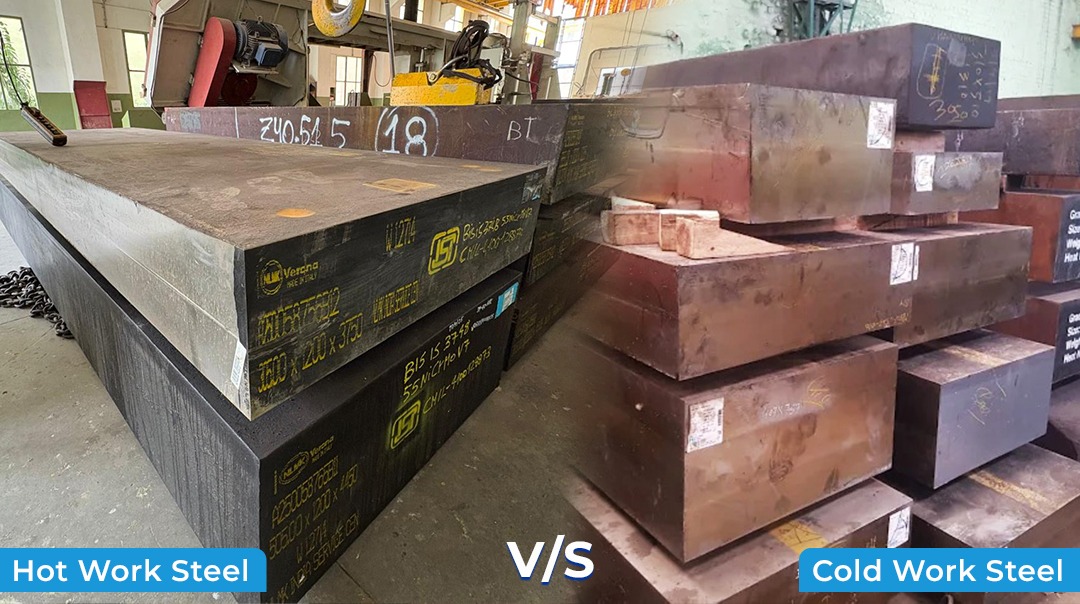
In tooling, one decision quietly determines tool life, rejection rate, and production cost: choosing the right tool steel Hot Work vs Cold Work Tool Steel .
Yet many failures on the shop floor come down to one mistake—using hot work steel where cold work is needed, or vice versa.
This guide will give you a clear, practical comparison between hot work and cold work tool steels—so you can make the right decision the first time.
Hot Work Tool Steel (For High Temperature Applications)
The most widely used grade: H13 tool steel
Best For:
- Aluminium die casting
- Forging dies
- Extrusion tools
- High-temperature moulds
Key Benefits:
✔ Handles extreme heat (200–700°C)
✔ Resists thermal cracking
✔ High toughness under load
Cold Work Tool Steel (For Wear Resistance)
A leading grade: D2 tool steel
Best For:
- Blanking & punching dies
- Shear blades
- Cold forming tools
- Sheet metal industry
Key Benefits:
✔ Very high hardness (up to 60+ HRC)
✔ Excellent wear resistance
✔ Long life in cutting operations
Hot Work vs Cold Work Steel — Quick Comparison
| Feature | Hot Work Steel (H13) | Cold Work Steel (D2) |
| Temperature | High | Low |
| Hardness | Medium | Very High |
| Toughness | High | Moderate |
| Wear Resistance | Medium | Very High |
| Heat Resistance | Excellent | Poor |
| Best Use | Die casting, forging | Cutting, punching |
Using the Wrong Steel? Here’s What Happens
- Cold work steel in hot application → Cracks & failure
- Hot work steel in wear application → Rapid wear & loss of accuracy
Result: Downtime, rejection, and higher cost per component
How to Choose the Right Tool Steel
Choose Hot Work Steel if:
- Temperature > 200°C
- Thermal cycling is involved
- Impact load is high
Choose Cold Work Steel if:
- Application is at room temperature
- Wear resistance is critical
- Cutting or shearing is involved
Industry-Wise Recommendation
| Industry | Recommended Steel |
| Die Casting | H13 |
| Forging | H13 / H11 |
| Sheet Metal | D2 |
| Blanking | D2 / D3 |
| Plastic Mould (High Temp) | H13 |
Increase Tool Life — Proven Methods
For Hot Work Steels:
- Use ESR quality material
- Apply nitriding
- Ensure proper preheating
- Control cooling cycles
- Maintain correct hardness
- Use coatings (PVD)
- Avoid shock loading
- Ensure lubrication
Virat Steels — Your Tool Steel Partner
At Virat Steels, we help manufacturers reduce failure and increase tool life with the right material selection.
What You Get:
✔ Ready stock (rounds, flats, blocks)
✔ Ultrasonic tested material
✔ Fast delivery across India
✔ Technical guidance (not just supply)
Our Supply Network Across India
Virat Steels is a trusted supplier of Hot Work Tool Steel to customers across the major industrial hubs of India including Ahmedabad, Rajkot, Pune, Nashik, Aurangabad, Kolhapur, Belgaum, Chennai, Coimbatore, Hosur, Bengaluru, Hyderabad, Faridabad, Manesar, Bhiwadi, Gurugram, Delhi NCR, Ludhiana, Chandigarh, Haryana, Punjab, Jamshedpur.
Our strong logistic network and efficient distribution system enable us to ensure timely PAN India dispatch to meet the requirement of tool rooms, die manufacturers, forging industries and engineering companies across the country.
H13 Tool Steel
FAQ
1-Which is better: H13 or D2?
It depends on application.
- High temperature → H13
- High wear → D2
2-Can D2 be used for hot work?
No. D2 tool steel becomes brittle at high temperatures and may crack.
3-Does higher hardness mean better tool life?
Not always. Excess hardness reduces toughness and increases cracking risk.
4-What is the best steel for die casting?
H13 tool steel is the industry standard.
5. How does heat treatment differ between the two?
Hot work steels are heat-treated to maintain strength at high temperatures
Cold work steels are treated to achieve maximum hardness and wear resistance
6. Which is more expensive: hot work or cold work steel?
Hot work steels are often more expensive due to alloying elements and processing required for high-temperature performance.
7. What industries rely heavily on hot work steel?
Automotive forging, Aluminium die casting, Aerospace component manufacturing
8. What industries rely on cold work steel?
Sheet metal fabrication, Tool and die making, Packaging and appliance manufacturing
9. Which steel has longer tool life?
It depends on the application:
- Hot work steel lasts longer in high-temperature application.
- Cold work steel lasts longer in abrasive, low-temperature operations.
Get Expert Recommendation (Free Consultation)
Choosing the right steel can double your tool life.
- Stop tool failures before they happen.
- Choose the right steel with expert guidance from Virat Steels.
Share your application—we’ll recommend:
- Best grade with quality
- Ideal hardness
- Heat treatment process
Talk to our experts today:
🌐 viratsteels.com 📞 +91 98140-21775 ✉ info@viratsteels.com