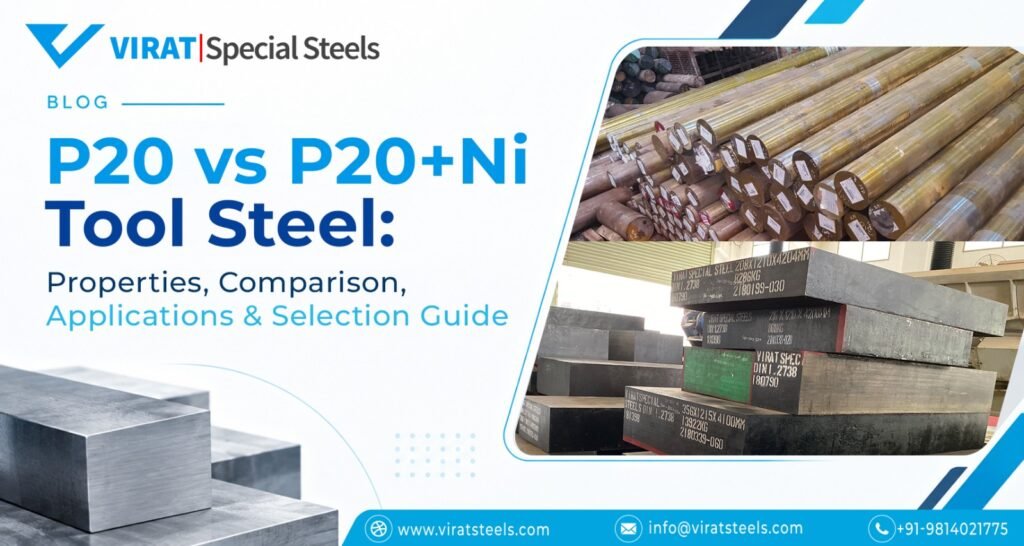
In the world of manufacturing, the choice of material plays a crucial role in determining the success of a product. When it comes to plastic molding and tooling applications, one steel always stands out for its exceptional properties and versatility: P20+NI tool Steel . This steel, also known as AISI P20+NI, has gained significant popularity in the mechanical and electrical industries.
Understanding P20+NI Tool steel :
P20 steel or AISI P20 usually consists of:
- Carbon (C):0.28% to 0.40D44
- Silicon (Si):0.20% to 0.80 D44
- Manganese (Mn):0.60% to 1.00 D44
- Phosphorus (P):0.03% maximum
- Sulphur (S):0.03% maximum
- Chromium (Cr):1.40% to 2.00D44
- Molybdenum (Mo):0.30% to 0.55D44
- Nickel (Ni):0.80% to 1.20D44
P20+NI is an enhanced version of P20 steel, with the addition of nickel (Ni) to improve its properties includes high hardness & tensile strength , Excellent Machinability , Good Toughness and Impact Resistance facilitates the manufacturing process and helps reduce production costs. It falls under the category of plastic mould tool steels and exhibits remarkable attributes that make it highly suitable for various applications.
Applications in the Mechanical Industry P20+NI tool Steel :
Injection Moulding Tooling: P20+NI’s remarkable qualities make it a popular choice for injection mould production. It can sustain dimensional stability and accuracy even under extreme pressure and heat throughout the injection molding process. Because of its durability and resilience to wear, steel is the perfect material for accurately creating huge quantities of plastic components.
Extrusion Tooling: P20+NI is used in the extrusion procedures for die and tooling component fabrication. It can withstand the high temperatures and pressures involved in plastic extrusion, ensuring the accurate shaping of profiles and tubes.
Applications in the Electrical Industry
Electrical Connectors and Housings: P20+NI is used in the manufacture of moulds for electrical connections and housing due to exceptional machinability. Hence these components are very precise, durable
Circuit Breaker Components: P20+NI tool steel combination of strength, toughness, and machinability makes it an ideal choice for manufacturing circuit breaker components such as contacts, terminals, and insulators.
# P20+NI tool steel with its unique blend of properties, leading the way as a top choice and a trusted material in the mechanical and electrical industries.
If you need more information or advice on # P20+NI tool steel ,please explore with Virat Special Steels , a leading supplier of tool steels in India and abroad can provide you with high-quality # P20+NI tool steel in various forms and sizes, as well as heat treatment and machining services.
Chemical Composition of P20+Ni Tool Steel
| Element | Composition |
|---|---|
| Carbon (C) | 0.28–0.40% |
| Silicon (Si) | 0.20–0.80% |
| Manganese (Mn) | 0.60–1.00% |
| Phosphorus (P) | Max 0.03% |
| Sulphur (S) | Max 0.03% |
| Chromium (Cr) | 1.40–2.00% |
| Molybdenum (Mo) | 0.30–0.55% |
| Nickel (Ni) | 0.80–1.20% |
Mechanical Properties of P20+Ni Steel
- Pre-hardened condition: 280–320 HB
- Excellent toughness
- High tensile strength
- Good impact resistance
- Excellent machinability
- Uniform hardness across thick sections
- Superior polishing ability
- Good weldability
- Excellent dimensional stability
Advantages of P20+Ni Tool Steel
Excellent Machinability
P20+Ni is supplied pre-hardened, eliminating additional hardening after machining in many applications. This reduces manufacturing time and tooling costs.
Superior Toughness
Nickel significantly improves impact resistance, making the steel suitable for large moulds subjected to repeated production cycles.
Outstanding Polishability
Mirror-finish moulds can be achieved with ease, making it suitable for transparent plastic products and premium consumer goods.
Uniform Hardness
Unlike ordinary mould steels, P20+Ni maintains consistent hardness throughout thicker blocks, reducing distortion during machining.
Long Tool Life
Its balanced wear resistance and toughness help increase mould life while minimizing maintenance.
Heat Treatment of P20+Ni Steel
Although supplied pre-hardened, additional heat treatment can be performed when required.
Annealing
- Temperature: 710–740°C
- Slow furnace cooling
Stress Relieving
- Temperature: 500–600°C
Hardening
- Austenitizing: 840–870°C
- Oil or gas quenching
Tempering
- 180–650°C depending on required hardness
Proper heat treatment enhances wear resistance and extends service life.
P20 vs P20+Ni Tool Steel
| Property | P20 | P20+Ni |
|---|---|---|
| Toughness | Good | Excellent |
| Hardness Uniformity | Good | Excellent |
| Polishability | Good | Superior |
| Large Mould Performance | Moderate | Excellent |
| Wear Resistance | Good | Better |
| Tool Life | Good | Longer |
Request a Quote Today
✔ Material Recommendation
✔ Ready Stock
✔ MTC Available
✔ UT Tested
✔ Spectro Tested
✔ PAN India Delivery
Call us or send your drawing to receive a customised material recommendation.
Call us: +91-98140 21775 Email: info@viratsteels.com Visit us: Gurgaon (Haryana) | Ludhiana (Punjab)
Frequently Asked Questions (FAQ)
1. What is P20+Ni tool steel?
P20+Ni is a nickel-alloyed pre-hardened plastic mould steel (DIN 1.2738) known for excellent toughness, machinability, polishability, and dimensional stability.
2. What is the hardness of P20+Ni steel?
P20+Ni is generally supplied in a pre-hardened condition of 280–320 HB (approximately 30–34 HRC).
3. What is the difference between P20 and P20+Ni?
P20+Ni contains nickel, providing better toughness, improved hardness uniformity, enhanced polishability, and longer mould life compared to standard P20 steel.
4. What are the common applications of P20+Ni?
It is widely used for injection moulds, blow moulds, automotive moulds, electrical housings, packaging moulds, and consumer product tooling.
5. Can P20+Ni steel be welded?
Yes. P20+Ni has good weldability when proper welding procedures and post-weld stress relieving are followed.