A practical, application-first guide for mould makers, tool rooms, and procurement teams choosing between two most popular plastic mould steel grades.
Choosing the wrong mould steel doesn’t just cost money — it costs production runs, surface finish quality, and mould life. Here’s how to pick the right one.
At a Glance: P20 vs H13
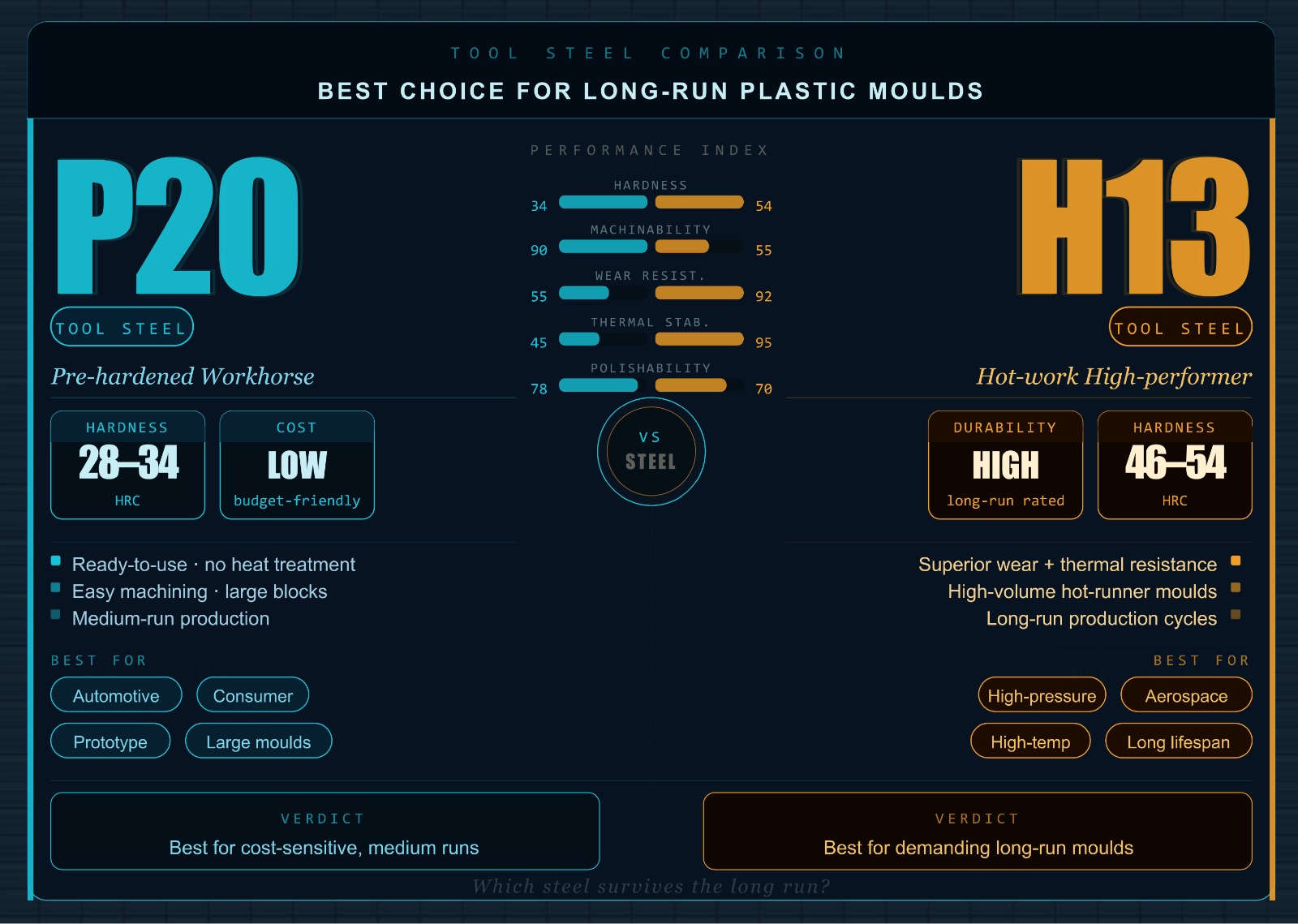
The table below gives a side-by-side view of both grades across the most critical properties mould buyers evaluate:
| P20 Steel Pre-hardened Mould Steel | H13 Steel Hot Work Tool Steel |
|---|---|
| Hardness 28–34 HRC (pre-hardened) | Hardness 44–52 HRC |
| Toughness High | Toughness Very High |
| Polishability Good | Polishability Excellent |
| Machinability Excellent | Machinability Moderate |
| Mould Life Up to 5,00,000 shots | Mould Life 10,00,000+ shots |
| Heat Treatment Not required | Heat Treatment Required (vacuum) |
| Tool Cost Lower | Tool Cost Higher |
| Lead Time Short | Lead Time Longer |
Detailed Property Comparison
| Property | P20 Steel | H13 Steel |
|---|---|---|
| Hardness after HT | 28–34 HRC (pre-hardened) | 44–52 HRC |
| Wear Resistance | Moderate | High |
| Toughness | High | Very High |
| Machinability | Excellent (no HT needed) | Moderate (HT required) |
| Thermal Fatigue Resistance | Low | Very High |
| Tool Cost | Lower | Higher |
| Lead Time | Short (ready to machine) | Longer (HT required) |
| Mould Life | Up to 5,00,000 shots | 10,00,000+ shots |
| Corrosion Resistance | Low | Moderate |
Which Steel is Best for Long-Run Moulds?
✅ Choose P20 if:
· Production volume is moderate
· Budget is limited
· Faster delivery is required
· Plastic material is non-abrasive
✅ Choose H13 if:
· Production volume is very high
· You need long mould life
· Material is abrasive or high temperature
· Dimensional stability is critical
| Which Grade Should You Pick? P20 for speed & cost · H13 for volume & finish |
If you need a mould quickly, at a lower cost, for regular plastics and medium production, go with P20.But if you’re producing in high volumes, using abrasive or glass-filled materials, or need a long-lasting, mirror-finish mould (over 10 lakh shots), choose H13.
Industry Applications in India
Both P20 and H13 are widely used across India’s plastics and automotive tooling industry. Here’s where each grade dominates:
| Industry | Recommended Grade | Reason |
|---|---|---|
| Automotive | H13 | High volume, tight tolerances, long mould life |
| Consumer Appliances | P20 | Medium run, cost-sensitive, faster delivery |
| Packaging (Caps & Closures) | H13 | Very high shot count, abrasion resistance |
| Electronics Housing | P20 / H13 | Depends on run volume and finish requirements |
| Medical Device Components | H13 (ESR Grade) | Mirror finish, cleanliness, long run |
| Soft Tooling | P20 | Quick machining, lower cost, short lead time |
Conclusion
Both P20 and H13 have their place in mould manufacturing—but the choice depends on your production goals:
· P20 = Cost-effective + faster production
· H13 = Long life + high performance
Sourcing P20 and H13 in India
Virat Special Steels stocks both P20 and H13 in ready inventory — supplied with full mill test certificates, hardness test reports, and chemical analysis. Available in round bars, flat bars, and pre-machined blocks across a wide size range.
| Need P20 or H13 for Your Next Mould? Get a fast quote — certified stock, ready to dispatch across India |
Contact our team to get more details about available sizes and technical specifications suitable for your applications.
https://www.viratsteels.com/products.html info@viratsteels.com +91 98140-21775
Frequently Asked Questions
1. Which is better for long-run plastic moulds, P20 or H13?
H13 — higher hardness, wear resistance, and heat tolerance make it ideal for long runs.
2. What is the difference between P20 and H13?
P20: Pre-hardened, easier to machine, lower cost — best for short/medium runs. H13: Heat-treated, stronger, better for high-temp and high-volume applications.
3. Is H13 worth the higher cost?
Yes — for high-volume production, H13 delivers better ROI over time.
4. When should you choose P20 over H13?
When volume is low/medium, budget is tight, or faster machining/delivery is needed.
5. Which is better for high-temperature injection molding?
H13 — superior thermal fatigue resistance handles higher temps without deformation.
6. Can P20 be used for long-run moulds?
Yes, but it wears faster with abrasive materials and isn’t ideal for very long runs.
7. Which industries prefer H13?
Automotive, electronics, and high-volume packaging — anywhere durability matters.
8. What’s the cost difference?
P20: Lower upfront. H13: Higher initial cost, but better long-term value.
9. Best steel for 1 million cycle production?
H13 — built to withstand extended wear, heat, and stress over massive run counts.