

VMO Steel

Grade Brief:

The steel grade VMO refers to a high-strength alloy steel produced in Brazil, typically used in applications requiring superior mechanical properties. V: Vanadium, which improves strength, toughness, and wear resistance. M: Molybdenum, which enhances high-temperature strength and corrosion resistance. O: Other alloying elements that contribute to the steel’s properties.


The equivalent grade DB6 / DIN 2714 / SKT4 normally used as a pre hardened condition. This steel grade is commonly used in industries such as automotive, aerospace, and construction, where both high strength and durability are essential. Its specific chemical composition can vary depending on the manufacturer and application, but VMO steel is generally designed for high-performance industrial use.


The VMO steel grade from Brazil, also known as ABNT VMO, is a type of special steel primarily used for hot work applications, such as forging dies in high-performance drop hammers. Here are some key details about this steel grade:


Consult our Gurugram office for further assistance.
Meanwhile for more on Virat Special Steels;
Email Us: info@viratsteels.com.
Contact them by mobile numbers 98140 – 21775, 99991 – 24971 to 79.

Follow on LinkedIn


Mode of Supply

Virat Special Steels is the largest stockiest and supplier of VMO Steel in flat, square and round bar. We provide steel in all sizes as your requirements. VMO Steel die steel is available in flat, square and round shape. Consult our team who will assist you for VMO steel query.


VMO Steel GradE


Steel Properties

The working hardness of ABNT VMO Steel typically ranges between 180 to 220 Brinell Hardness Number (BHN). This range makes it suitable for hot work applications, providing a good balance of strength and toughness. This steel grade is the upgrade version of DIN 2713 for better
performance.


Chemical Composition:
Carbon © 0.57%
Silicon (Si) 0.25%
Manganese (Mn) 0.70%
Sulfur (S) 1.10%
Chromium (Cr) 0.50%
Molybdenum (Mo) 1.65%


Mechanical Properties:
Yield Strength (Rp0.2) ≥ 655 MPa
Tensile Strength (Rm) ≥ 821 MPa
Impact Toughness (KV/Ku) 42 J
Elongation (A) 11%
Reduction in Cross Section on Fracture (Z) 22%


VMO steel is commonly used in the manufacturing of tools and dies that require high strength and toughness, especially in hot working environments.


VMO Brazil Steel Common Properties:


1. High Strength:
VMO steel has excellent tensile strength due to the presence of alloying elements like Vanadium and Molybdenum. It can handle heavy loads and resist deformation under stress.


2. Toughness:
This steel grade exhibits superior toughness, meaning it can absorb energy and withstand impacts without breaking or cracking.


3. Wear Resistance:
VMO steel’s composition makes it highly resistant to wear, ensuring longer service life in applications involving friction or repeated mechanical stress.


4. Corrosion Resistance:
The presence of Molybdenum and Chromium provides excellent resistance to corrosion, particularly in harsh or high-temperature environments, making it ideal for chemical, oil & gas, and marine industries.


5. Fatigue Resistance:
This steel performs well under cyclic loads, meaning it can endure repeated stress without weakening, which is important for parts like gears or shafts.


Physical Properties of VMO Brazil Steel Grade:

1. Density:
The typical density of VMO steel is around 7.8 g/cm³, similar to other high-strength steels.

2. Melting Point:
The melting point of VMO steel is approximately 1400°C to 1500°C, depending on its exact alloy composition.

3. Modulus of Elasticity:
This steel has a modulus of elasticity in the range of 200-210 GPa, ensuring good stiffness and resistance to elastic deformation.

4. Thermal Conductivity:
VMO steel has a lower thermal conductivity than carbon steels, typically in the range of 20-25 W/m·K, which means it does not conduct heat as efficiently as lower alloy steels.

5. Coefficient of Thermal Expansion:
The coefficient of thermal expansion is about 12 x 10^-6 /K, meaning it expands moderately when subjected to high temperatures, but remains stable under operational conditions.


Heat Treatment & Processes for VMO Steel:

1. Annealing:
Annealing is done by heating the steel to 850-950°C, followed by slow cooling to relieve internal stresses and improve ductility and machinability. This softens the material for further processing.
2. Quenching:
Quenching is a critical process for VMO steel. It involves heating the steel to 900-950°C and then rapidly cooling it in oil or water. This process increases the hardness and tensile strength but can make the steel more brittle.

3. Tempering:
After quenching, tempering is used to adjust the hardness and improve toughness. The steel is reheated to 200-600°C and then cooled slowly. Higher tempering temperatures produce softer but tougher material, while lower temperatures maintain more hardness.

4. Normalizing:
In some cases, normalizing is used to refine the grain structure by heating the steel to around 900°C followed by air cooling. This enhances toughness and reduces internal stresses, improving mechanical properties.

5. Surface Hardening (Carburizing/Nitriding):
For specific applications where surface hardness is crucial (e.g., gears), surface treatments like carburizing or nitriding can be used. These processes add carbon or nitrogen to the steel surface, increasing hardness while maintaining a tough core.

6. Stress Relieving:
Stress relieving is often applied after welding or machining to remove residual stresses. The steel is heated to 500-650°C and then slowly cooled to prevent distortions or fractures in the final product.


Applications

VMO steel is often used in environments requiring materials to withstand extreme stress, heat, or wear. This makes it a preferred choice in:

Automotive: For parts like gears, crankshafts, and connecting rods.
Aerospace: In high-performance aircraft parts that require both strength and resistance to extreme conditions.
Oil & Gas: For components used in drilling and extraction equipment, where both high strength and resistance to corrosion are critical.
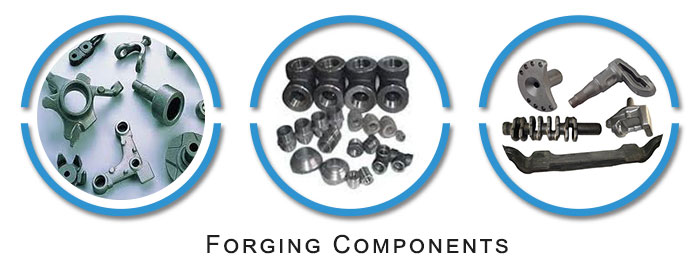
 

Forging-Components


Addition to other Grades:

HCHCR-D2 Steel , HCHCR-D3 Steel , P20+Ni Steel , P20 Steel , DB6 Steel , H13 Steel, H11 Steel, H21 Steel, H10 Steel, H12 Steel, M2 Steel, M35 Steel, M42 Steel, T1 Steel, DIN 2379 Steel, DIN 2080 Steel, DIN 2738 Steel, DIN 2311 Steel, DIN 2714 Steel, DIN 2344 Steel , DIN 2343 Steel, DIN 2581 Steel, DIN 2365 Steel, DIN 2606 Steel, DIN 3343 Steel, DIN 3243 Steel, DIN 3247 Steel, DIN 3355 Steel AISI D2 Steel, AISI D3 Steel, AISI P20+Ni Steel, AISI P20 Steel, AISI L6 Steel , AISI H13 Steel, AISI H11 Steel, AISI H21 Steel, AISI H10 Steel, AISI H12 Steel, AISI M2 Steel, AISI M35 Steel, AISI M42 Steel , AISI T1 Steel


Our Global Presence:

India, Nepal, Dubai, Thailand, Vietnam, Saudi Arabia, United Arab Emirates , Qatar, Kuwait, Iran, Turkey, Portugal, Spain, Poland, UK, USA, Canada, Brazil, Mexico, Belarus, Australia, New Zealand and many more..


We Provide our Special Steels in All Major Cities India.

Agra, Alwar,Ambala, Anand, Bhiwadi, Dehradun, Ghaziabad, Haridwar, Rudrapur, Delhi, Faridabad, Kanpur, Noida, Gurgaon, Manesar, Kundali ,  Chandigarh,  Waluj , Vadodara, Pimpri – Chinchwad, Rajkot, Jaipur, Ahmedabad, Pithampur,  Surat,  Amravati, Vadodara, Indore,  Bhopal, Ranchi, Jamshedpur, Howrah, Kolkata, Pune, Thane, Nashik, Mumbai, Navi Mumbai, Nagpur,  Ambattur, Bangalore, Belgaum, Chittoor, Dindigul, Hyderabad,  Ernakulam,  Chennai, Secunderabad, Visakhapatnam, Coimbatore, Mysore, Nellore, Kochi,  Thiruvananthapuram, Trivandrum, Vijayawada, Guntur, Tirupati, Nazarathpet, Kakinada, Kurnool and many more..


HXM 24 Steel

Grade Brief:

HXM 24 Steel is a high-hardness, pre-hardened tool steel commonly used for applications requiring strength, durability, and resistance to wear. HXM 24 steel is ideal for high-performance applications where wear resistance, toughness, and machinability are critical. Its properties make it suitable for demanding industrial tooling, molding, and die-casting environments.


HXM 24 is closely related to the widely used P20+Ni / DIN 1.2738 / AISI P20+Ni tool steel, but they do have some differences:


HXM 24 Steel  is with High Hardness 360-400 BHN and increase alloy elements to get extra life and outstanding polishing. Both HXM 24 and P20+Ni steels contain similar base elements such as carbon, chromium, manganese, and molybdenum. However, HXM 24 may have specific additives or adjusted compositions to enhance certain properties like hardness or toughness


P20+Ni is supplied in a pre-hardened condition with a hardness range of around 280-320 HB (BHN). It can be nitrided or further surface-hardened after machining. HXM 24 is typically harder in its pre-hardened state, with the ability to reach higher hardness levels without losing machinability, making it more suitable for applications where greater hardness is essential.


P20+Ni (DIN 1.2738) is often used for large plastic molds, die casting dies, and base plates. HXM 24 is used where high hardness and wear resistance are necessary in addition to toughness, making it more versatile for tooling that experiences high wear.


In summary, while both HXM 24 and P20+Ni steels are tool steels with overlapping applications, HXM 24 offers enhanced hardness and wear resistance compared to P20+Ni.


Here is a detailed overview of its properties:


1. Chemical Composition:
The exact composition may vary slightly based on the manufacturer, but typically it contains:


  • Carbon (C): 0.35 – 0.45%
  • Chromium (Cr): 1.8 – 2.0%
  • Manganese (Mn): 0.6 – 1.0%
  • Molybdenum (Mo): 0.3 – 0.5%
  • Nickel (Ni): 0.9 – 1.2%
  • Silicon (Si): 0.2 – 0.4%
  • Sulfur (S) and Phosphorus (P): Typically low or controlled, as excessive amounts can lead to brittleness.


2. Mechanical Properties:

  • Hardness: Typically delivered in a pre-hardened state with hardness ranging from 310-360 HB (Brinell hardness). It can be heat-treated to achieve even higher hardness levels, up to 38-42 HRC.
  • Tensile Strength: ~ 1000 – 1200 MPa in the pre-hardened condition.
  • Yield Strength: ~ 850 – 1000 MPa, depending on the tempering process.
  • Impact Toughness: Exhibits good impact toughness, making it suitable for tooling and die applications that endure shock loading.


3. Physical Properties:

  • Density: ~ 7.85 g/cm³
  • Thermal Conductivity: Approximately 30-35 W/m-K, depending on the temperature.
  • Coefficient of Thermal Expansion: ~ 12 x 10⁻⁶ /K
  • Modulus of Elasticity: ~ 210 GPa


4. Heat Treatment & Processes

  • Annealing: HXM 24 can be annealed by heating to around 710-740°C, followed by slow cooling in the furnace to reduce hardness and improve machinability if needed.
  •  Hardening: The steel is generally delivered in a pre-hardened condition, but for specific applications, it can be hardened by heating it to 870-900°C, followed by air or oil quenching.
  • Tempering: After hardening, tempering is usually performed at around 500-600°C to adjust the hardness and toughness according to the desired application. Tempering helps relieve internal stresses and improves the toughness without significantly lowering hardness.


5. Machinability:
HXM 24 is known for its good machinability in its pre-hardened state, making it easier to process into molds, dies, and tools without the need for post-machining hardening processes. Its machinability rating is around 80% relative to other tool steels.


6. Applications:
HXM 24 steel is used in a variety of high-demand industries that require a balance between toughness, machinability, and hardness, such as:


  • Plastic Molds: Used for large, intricate plastic molds where dimensional stability and wear resistance are important.
  • Die Casting Dies: Suitable for molds used in aluminum, zinc, and magnesium die casting where high wear resistance is required.
  • Extrusion Tools: Used in the production of dies for plastic extrusion.
  • Press and Injection Molds: For molds requiring resistance to wear and high impact.
  • Automotive and Aerospace: Used in tooling and die applications in the automotive and aerospace industries where precision and durability are critical.


7. Key Features:

  • Wear Resistance: Excellent wear resistance due to its high hardness.
  • Dimensional Stability: Good dimensional stability under heat and stress.
  • Corrosion Resistance: Limited corrosion resistance but can be enhanced with surface treatments.
  • Toughness: Good toughness and impact resistance, especially in the hardened and tempered condition.
  • Weldability: Can be welded with appropriate pre- and post-heating treatment, but welding is generally not recommended unless necessary.


HXM 24 steel is ideal for high-performance applications where wear resistance, toughness, and machinability are critical. Its properties make it suitable for demanding industrial tooling, molding, and die-casting environments.


Consult our Gurugram office for further assistance.
Meanwhile for more on Virat Special Steels;
Email Us: info@viratsteels.com.
Contact them by mobile numbers 98140 – 21775, 99991 – 24971 to 79.

Follow on LinkedIn


Mode of Supply

Virat Special Steels is the largest stockiest and supplier of HXM 24 Steel in flat, square and round bar. We provide steel in all sizes as your requirements. HXM 24 Steel is available in flat, square and round shape. Consult our team who will assist you for HXM 24 Steel query.


HXM 24


Addition to other Grades:

HCHCR-D2 Steel , HCHCR-D3 Steel , P20+Ni Steel , P20 Steel , DB6 Steel , H13 Steel, H11 Steel, H21 Steel, H10 Steel, H12 Steel, M2 Steel, M35 Steel, M42 Steel, T1 Steel, DIN 2379 Steel, DIN 2080 Steel, DIN 2738 Steel, DIN 2311 Steel, DIN 2714 Steel, DIN 2344 Steel , DIN 2343 Steel, DIN 2581 Steel, DIN 2365 Steel, DIN 2606 Steel, DIN 3343 Steel, DIN 3243 Steel, DIN 3247 Steel, DIN 3355 Steel AISI D2 Steel, AISI D3 Steel, AISI P20+Ni Steel, AISI P20 Steel, AISI L6 Steel , AISI H13 Steel, AISI H11 Steel, AISI H21 Steel, AISI H10 Steel, AISI H12 Steel, AISI M2 Steel, AISI M35 Steel, AISI M42 Steel , AISI T1 Steel


Our Global Presence:

India, Nepal, Dubai, Thailand, Vietnam, Saudi Arabia, United Arab Emirates , Qatar, Kuwait, Iran, Turkey, Portugal, Spain, Poland, UK, USA, Canada, Brazil, Mexico, Belarus, Australia, New Zealand and many more..


We Provide our Special Steels in All Major Cities India.

Agra, Alwar,Ambala, Anand, Bhiwadi, Dehradun, Ghaziabad, Haridwar, Rudrapur, Delhi, Faridabad, Kanpur, Noida, Gurgaon, Manesar, Kundali ,  Chandigarh,  Waluj , Vadodara, Pimpri – Chinchwad, Rajkot, Jaipur, Ahmedabad, Pithampur,  Surat,  Amravati, Vadodara, Indore,  Bhopal, Ranchi, Jamshedpur, Howrah, Kolkata, Pune, Thane, Nashik, Mumbai, Navi Mumbai, Nagpur,  Ambattur, Bangalore, Belgaum, Chittoor, Dindigul, Hyderabad,  Ernakulam,  Chennai, Secunderabad, Visakhapatnam, Coimbatore, Mysore, Nellore, Kochi,  Thiruvananthapuram, Trivandrum, Vijayawada, Guntur, Tirupati, Nazarathpet, Kakinada, Kurnool and many more..


DB6 Steel

Grade Brief:

DB6 is highly recommendable for Close Die Forgings due to its characteristics of high wear-resistance, extra toughness , high hardness which is achieved with Cr-Ni-Mo-V high graded alloys. The equivalent grade DB6 / L6 / SKT4 normally used as a pre hardened condition. The standard hardness is 360 to 430 BHN. DIN 2714 is the upgraded version of DIN 2713 for better performance of dies. We supply Die blocks as the extra Forging Reduction & Upsetting with Double tempered to achieve the better Ultrasonic quality.


DB6 Steel is a tool steel grade that comes under the DIN EN ISO 4957 standard. Due to its excellent combination of wear resistance, additional toughness, and high hardness which are attained using Cr-Ni-Mo-V high graded alloys, DB6 Steel is highly recommended for Close Die Forgings. Therefore, DB6 Steel is the material of choice in the automotive, aerospace, metalworking, and tool and die sectors. We provide die blocks as an additional forging reduction and upsetting step with double tempering to improve ultrasonic quality.


Consult our Gurugram office for further assistance.
Meanwhile for more on Virat Special Steels;
Email Us: info@viratsteels.com.
Contact them by mobile numbers 98140 – 21775, 99991 – 24971 to 79.

Follow on LinkedIn


Mode of Supply

Virat Special Steels is the largest stockiest and supplier of DB6 Steel in flat, square and round bar. We provide steel in all sizes as your requirements. DB6 die steel is available in flat, square and round shape. Consult our team who will assist you for DB6 steel query.


DB-6


Steel Properties

The special Hot Work Pre hardened Steel with good toughness and high ware resistance. Die Steel is normally supply in hard, quenched & tempered and also in annealed condition in special case. Usually its working hardness is 360-430 BHN. This steel grade is the upgrade version of DIN 2713 for better
performance.


Mechanical Properties:
Tensile strength 1000-1400 MPa
Yield Strength 1045 MPa
Elongation 15%-20%
Impact Toughness 20 J/cm2-25 J/cm2
Hardness 50-55 HRC
Compressive Strength 2500MPa
Modulus of elasticity 205 GPa


Physical Properties

The exact values of these physical characteristics depend on the composition, heat treatment, and manufacturing procedures used to create DB6 steel, so take them with a grain of salt. For detailed details on the physical characteristics of a certain grade of DB6/DIN 2714/AISI L6 steel, it is always advised to refer to the manufacturer’s datasheet or specifications.


Coefficient of thermal expansionat °C 20-100 20-200 20-300 20-400 20-500 20-600
10-6 m/(m*K) 12.1 13.1 13.2 13.5 14.1 14.3


Thermal Conductivity °C 20 350 700
W/(m*K) 35.0 39.0 36.0


DB6 Steel Hardness:

Different hardness according to different Tempering temperature conditions.
– Annealed condition – 255 BHN max
– Hardened and Tempered condition- 38 to 42 HRC
– Hardness variation from surface to core – 20 to 25 BHN


Machinability:

The machinability of tool steel DB6 Steel is very good & It rates 90% of the machinability of the W-group water hardening low alloy steels rated 100% as a baseline.


Heat Treatment & Processes:

Heat Treatment:

Based on the desired hardness, toughness, and other mechanical properties of the steel required for the particular application, such as shape and size, the precise heat treatment of DB6 Steel / DIN 1.2714 / AISI L6 steel parameters, including rate of heating, austenitizing temperature, cooling, soaking time, quenching media, and tempering temperature, may vary.


Hardening:

Preheating at 650°C, quickly raising the temperature to the hardening range of 900–950°C, and quenching in oil.


Tempering:

Tempering after-hardening values /MPa|400°C: 1770,
Tempering after-hardening values /MPa|500℃: 1570 ,
Tempering after-hardening values /MPa|600°C: 1320,
Tempering after-hardening values /MPa|650℃: 1180


Forging :

Gradually Warm up to 700 °C, then quickly raise the temperature to 1050 °C. Keep forging over 800 °C. After forging, it is important to cool slowly, either in a furnace or in a vermiculite.


Stress Relieving:

Heat the component gently to 600–650°C for stress release, and then give it a thorough soak for two hours every 25mm of section. Cool to 500°C in the boiler before circulating freely. Before hardening, tools can then be finished machining.


Normalizing:

DB6 Steel / DIN 1.2714 / AISI L6 – Hot-Work Mold Steel should not be normalized due to its air-hardening ability .


Annealing:

Soak Thoroughly at 740-760 °C before furnace cooling at a maximum rate of 10 °C per hour down to 600 °C followed by cooling in air.


Cold working:

Cold working is needed for shaping or forming the material, it is generally recommended to perform the operations on the steel in its annealed or soft condition before the heat treatment process.


Nitriding:

DB6 Steel / DIN 1.2714 / AISI L6 steel can be nitride to give a hard surface case, The steel is very resistant to wear and erosion .Before nitriding the tool steel should be hardened and tempered at approx 50 °C above the nitriding temperature.


Welding:

Stress tempering for a pre hardened condition.


Quenching:

In order to produce the appropriate hardness and mechanical qualities for DB6/ DIN 1.2714 / AISI L6, quenching is a critical stage in the heat treatment process. The temperature range above the critical temperature (AC3) is required for quenching steel utilizing an oil and air medium in order to completely change the steel’s microstructure into a hardened condition.


Soft annealing °C Cooling Hardness HB
650-710 Furnace max. 240


Hardening °C Quenching Hardness after quenching HRC
840-880 Oil 57
860-900 Air 55


Tempering °C after quenching 100 200 300 400 450 500 550 600 650
in Oil – HRC 56 54 52 49 47 46 43 38 34
in Air – HRC 54 52 50 47 45 43 40 36 32

Application

Dies for Drop Forging Hammers & Mechanical Presses, Die Molds, Shoe Blocks, Die Holder, Cassettes, Piston Rods, Cranks, Boaster, Shearing Blades, Tools, plastic molds, Shafts Etc.


Forging-Components


Addition to other Grades:

HCHCR-D2 Steel , HCHCR-D3 Steel , P20+Ni Steel , P20 Steel , DB6 Steel , H13 Steel, H11 Steel, H21 Steel, H10 Steel, H12 Steel, M2 Steel, M35 Steel, M42 Steel, T1 Steel, DIN 2379 Steel, DIN 2080 Steel, DIN 2738 Steel, DIN 2311 Steel, DIN 2714 Steel, DIN 2344 Steel , DIN 2343 Steel, DIN 2581 Steel, DIN 2365 Steel, DIN 2606 Steel, DIN 3343 Steel, DIN 3243 Steel, DIN 3247 Steel, DIN 3355 Steel AISI D2 Steel, AISI D3 Steel, AISI P20+Ni Steel, AISI P20 Steel, AISI L6 Steel , AISI H13 Steel, AISI H11 Steel, AISI H21 Steel, AISI H10 Steel, AISI H12 Steel, AISI M2 Steel, AISI M35 Steel, AISI M42 Steel , AISI T1 Steel


Our Global Presence:

India, Nepal, Dubai, Thailand, Vietnam, Saudi Arabia, United Arab Emirates , Qatar, Kuwait, Iran, Turkey, Portugal, Spain, Poland, UK, USA, Canada, Brazil, Mexico, Belarus, Australia, New Zealand and many more..


We Provide our Special Steels in All Major Cities India.

Agra, Alwar,Ambala, Anand, Bhiwadi, Dehradun, Ghaziabad, Haridwar, Rudrapur, Delhi, Faridabad, Kanpur, Noida, Gurgaon, Manesar, Kundali ,  Chandigarh,  Waluj , Vadodara, Pimpri – Chinchwad, Rajkot, Jaipur, Ahmedabad, Pithampur,  Surat,  Amravati, Vadodara, Indore,  Bhopal, Ranchi, Jamshedpur, Howrah, Kolkata, Pune, Thane, Nashik, Mumbai, Navi Mumbai, Nagpur,  Ambattur, Bangalore, Belgaum, Chittoor, Dindigul, Hyderabad,  Ernakulam,  Chennai, Secunderabad, Visakhapatnam, Coimbatore, Mysore, Nellore, Kochi,  Thiruvananthapuram, Trivandrum, Vijayawada, Guntur, Tirupati, Nazarathpet, Kakinada, Kurnool and many more..


DIN 2714 Steel

Grade Brief:

DIN 1.2714 is highly recommendable for Close Die Forgings due to its characteristics of high wear-resistance, extra toughness , high hardness which is achieved with Cr-Ni-Mo-V high graded alloys. The equivalent grade DB6 / L6 / SKT4 normally used as a pre hardened condition. The standard hardness is 360 to 430 BHN. DIN 2714 is the upgraded version of DIN 2713 for better performance of dies. We supply Die blocks as the extra Forging Reduction & Upsetting with Double tempered to achieve the better Ultrasonic quality.


DIN 1.2714 is a tool steel grade that comes under the DIN EN ISO 4957 standard. Due to its excellent combination of wear resistance, additional toughness, and high hardness which are attained using Cr-Ni-Mo-V high graded alloys, DIN 2714 Steel is highly recommended for Close Die Forgings. Therefore, DIN 2714 Steel is the material of choice in the automotive, aerospace, metalworking, and tool and die sectors. We provide die blocks as an additional forging reduction and upsetting step with double tempering to improve ultrasonic quality.
Consult our Gurugram office for further assistance.
Meanwhile for more on Virat Special Steels;
Email Us: info@viratsteels.com.
Contact them by mobile numbers 98140 – 21775, 99991 – 24971 to 79.

Follow on LinkedIn


Popularly Searchable Keywords:

DIN 1.2714 Steel, DIN 2714 Steels, DIN 2714 Steel, DIN 2714 Steel Chemical composition, DIN 2714 Steel Mechanical properties, DIN 2714 Steel Equivalent Grades, DIN 2714 Steel plate, DIN 2714 Steel sheet, DIN 2714 Steel Manufacturers, DIN 2714 Steel Dealers, DIN 2714 Steel Stockist, DIN 2714 Steel Distributors, DIN 2714 Steel Wholesalers, DIN 2714 Steel Traders, DIN 2714 Steel Round Bar, DIN 2714 Steel Round Bar Manufacturers, DIN 2714 Steel Suppliers, DIN 2714 Steel Stockist, DIN 2714 Steel Dealers, DIN 2714 Steel Distributors, DIN 2714 Steel Wholesalers, DIN 2714 Steel Traders, DIN 2714 Steel Square Distributors, DIN 2714 Steel Flat Bar, DIN 2714 Die Steel Round Bar, DIN 2714 Hot Die Steel Traders, DIN 2714 Steel Companies Near me.


Mode of Supply

Virat Special Steels is the largest stockiest and supplier of DIN 2714 tool steel in flat, square and round bar. We provide steel in all sizes as your requirements. DIN 2714 die steel is available in flat, square and round shape. Consult our team who will assist you for DIN 2714 steel query.


din-2714-steel


Steel Properties

The special Hot Work Pre hardened Steel with good toughness and high ware resistance. Die Steel is normally supply in hard, quenched & tempered and also in annealed condition in special case. Usually its working hardness is 360-430 BHN. This steel grade is the upgrade version of DIN 2713 for better performance.


Mechanical Properties:
Tensile strength 1000-1400 MPa
Yield Strength 1045 MPa
Elongation 15%-20%
Impact Toughness 20 J/cm2-25 J/cm2
Hardness 50-55 HRC
Compressive Strength 2500MPa
Modulus of elasticity 205 GPa

Physical Properties

Coefficient of thermal expansionat °C 20-100 20-200 20-300 20-400 20-500 20-600
10-6 m/(m*K) 12.1 13.1 13.2 13.5 14.1 14.3


Thermal Conductivity °C 20 350 700
W/(m*K) 35.0 39.0 36.0


DIN 1.2714 Hardness:

Different hardness according to different Tempering temperature conditions.
– Annealed condition – 255 BHN max
– Hardened and Tempered condition- 38 to 42 HRC
– Hardness variation from surface to core – 20 to 25 BHN


Machinability:

The machinability of tool steel DIN 2714 is very good & It rates 90% of the machinability of the W-group water hardening low alloy steels rated 100% as a baseline.


Heat Treatment & Processes:

Heat Treatment:

Based on the desired hardness, toughness, and other mechanical properties of the steel required for the particular application, such as shape and size, the precise heat treatment of DIN 1.2714 steel parameters, including rate of heating, austenitizing temperature, cooling, soaking time, quenching media, and tempering temperature, may vary.


Hardening:

Preheating at 650°C, quickly raising the temperature to the hardening range of 900–950°C, and quenching in oil.


Tempering:

Tempering after-hardening values /MPa|400°C: 1770,
Tempering after-hardening values /MPa|500℃: 1570 ,
Tempering after-hardening values /MPa|600°C: 1320,
Tempering after-hardening values /MPa|650℃: 1180


Forging :

Gradually Warm up to 700 °C, then quickly raise the temperature to 1050 °C. Keep forging over 800 °C. After forging, it is important to cool slowly, either in a furnace or in a vermiculite.


Stress Relieving:

Heat the component gently to 600–650°C for stress release, and then give it a thorough soak for two hours every 25mm of section. Cool to 500°C in the boiler before circulating freely. Before hardening, tools can then be finished machining.


Normalizing:

DIN 1.2714 Hot-Work Mold Steel should not be normalized due to its air-hardening ability .


Annealing:

Soak Thoroughly at 740-760 °C before furnace cooling at a maximum rate of 10 °C per hour down to 600 °C followed by cooling in air.


Cold working:

Cold working is needed for shaping or forming the material, it is generally recommended to perform the operations on the steel in its annealed or soft condition before the heat treatment process.


Nitriding:

DIN 1.2714 steel can be nitride to give a hard surface case, The steel is very resistant to wear and erosion .Before nitriding the tool steel should be hardened and tempered at approx 50 °C above the nitriding temperature.


Welding:

Stress tempering for a pre hardened condition.


Quenching:

In order to produce the appropriate hardness and mechanical qualities for DIN 1.2714 Steel, quenching is a critical stage in the heat treatment process. The temperature range above the critical temperature (AC3) is required for quenching steel utilizing an oil and air medium in order to completely change the steel’s microstructure into a hardened condition.


Soft annealing °C Cooling Hardness HB
650-710 Furnace max. 240


Hardening °C Quenching Hardness after quenching HRC
840-880 Oil 57
860-900 Air 55


Tempering °C after quenching 100 200 300 400 450 500 550 600 650
in Oil – HRC 56 54 52 49 47 46 43 38 34
in Air – HRC 54 52 50 47 45 43 40 36 32

Application

Dies for Drop Forging Hammers & Mechanical Presses, Die Molds, Shoe Blocks, Die Holder, Cassettes, Piston Rods, Cranks, Boaster, Shearing Blades, Tools, plastic molds, Shafts Etc.


Addition to other Grades:

HCHCR-D2 Steel , HCHCR-D3 Steel , P20+Ni Steel , P20 Steel , DB6 Steel , H13 Steel, H11 Steel, H21 Steel, H10 Steel, H12 Steel, M2 Steel, M35 Steel, M42 Steel, T1 Steel, DIN 2379 Steel, DIN 2080 Steel, DIN 2738 Steel, DIN 2311 Steel, DIN 2714 Steel, DIN 2344 Steel , DIN 2343 Steel, DIN 2581 Steel, DIN 2365 Steel, DIN 2606 Steel, DIN 3343 Steel, DIN 3243 Steel, DIN 3247 Steel, DIN 3355 Steel AISI D2 Steel, AISI D3 Steel, AISI P20+Ni Steel, AISI P20 Steel, AISI L6 Steel , AISI H13 Steel, AISI H11 Steel, AISI H21 Steel, AISI H10 Steel, AISI H12 Steel, AISI M2 Steel, AISI M35 Steel, AISI M42 Steel , AISI T1 Steel


Our Global Presence:

India, Nepal, Dubai, Thailand, Vietnam, Saudi Arabia, United Arab Emirates , Qatar, Kuwait, Iran, Turkey, Portugal, Spain, Poland, UK, USA, Canada, Brazil, Mexico, Belarus, Australia, New Zealand and many more..


We Provide our Special Steels in All Major Cities India.

Agra, Alwar,Ambala, Anand, Bhiwadi, Dehradun, Ghaziabad, Haridwar, Rudrapur, Delhi, Faridabad, Kanpur, Noida, Gurgaon, Manesar, Kundali ,  Chandigarh,  Waluj , Vadodara, Pimpri – Chinchwad, Rajkot, Jaipur, Ahmedabad, Pithampur,  Surat,  Amravati, Vadodara, Indore,  Bhopal, Ranchi, Jamshedpur, Howrah, Kolkata, Pune, Thane, Nashik, Mumbai, Navi Mumbai, Nagpur,  Ambattur, Bangalore, Belgaum, Chittoor, Dindigul, Hyderabad,  Ernakulam,  Chennai, Secunderabad, Visakhapatnam, Coimbatore, Mysore, Nellore, Kochi,  Thiruvananthapuram, Trivandrum, Vijayawada, Guntur, Tirupati, Nazarathpet, Kakinada, Kurnool and many more..


P20+Ni tool Steel

Grade Brief:

P20+Ni tool steel is specially used for Plastic injection die moulds. The characteristics of a material are right sharpening, photo-etching properties with high purity and good homogeneity. P20+Ni is upgraded version of plastic mold steel 0f 2311, which normally supply in Pre hardened condition. Hardness in as supplied condition 280-320 HB with having uniform hardness. The additional nickel content of 1 % increases through hardening. It has good machinability, suitable for Texturing, fine polishability, adequate corrosion resistance, vacuum-degassed steel.


P20 +Ni tool Steel High Hard ( HXM 24 )

P20 +Ni tool Steel is with High Hardness 360-400 BHN and increase alloy elements to get extra life and outstanding polishing.


P20 +Ni tool Steel is a type of plastic mold steel that is similar to DIN 1.2738 / AISI P20+Ni Tool Steel. The alloying elements for hardness and toughness include nickel, chromium, and molybdenum. P20+Ni tool steel is intended specifically for the plastic mold industry, particularly for large steel mold components.
P20+Ni tool steel is often provided pre-hardened/quenched and tempered in the 280 – 320 HB hardness range. This makes it a great choice for applications involving high-temperature settings and difficult mechanical conditions.
P20 +Ni tool Steel have superior polishability compared to 1.2312 (AISI P20+S) and better machinability. To enhance the hardness and wearability of the mould surface material , it can be treated with nitrogenation and flame hardening. P20 +Ni tool Steel is melted in an electrical furnace and refined using a VOD or DH equipment.P20+Ni steel is a type of plastic mold steel that is similar to DIN 1.2738 /AISI P20+Ni Tool Steel. The alloying elements for hardness and toughness include nickel, chromium, and molybdenum. P20+Ni tool steel is intended specifically for the plastic mold industry, particularly for large steel mold components.


P20+Ni tool steel is often provided pre-hardened/quenched and tempered in the 280 – 320 HB hardness range. This makes it a great choice for applications involving high-temperature settings and difficult mechanical conditions.


P20 +Ni tool Steel have superior polishability compared to 1.2312 (AISI P20+S) and better machinability. To enhance the hardness and wearability of the mould surface material , it can be treated with nitrogenation and flame hardening. P20+Ni steel is melted in an electrical furnace and refined using a VOD or DH equipment.
Consult our Gurugram office for further assistance.
Meanwhile for more on Virat Special Steels;
Email Us: info@viratsteels.com.
Contact them by mobile numbers 98140 – 21775, 99991 – 24971 to 79.

Follow on LinkedIn


Mode of Supply

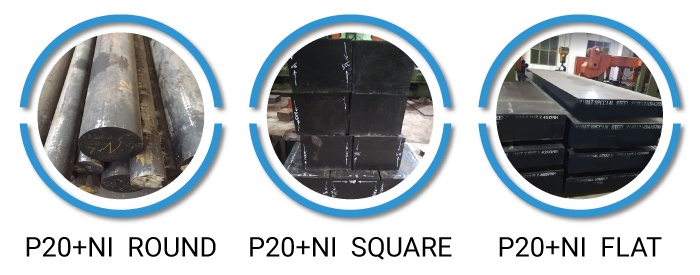
Virat Special Steels is the largest stockiest and supplier of P20 +Ni tool Steel in flat, square and round bar. We provide steel in all sizes as your requirements. P20+Ni die steel is available in flat, square and round shape. Consult our team who will assist you for P20 +Ni tool Steel query.


P20+Ni tool Steel


Steel Properties


DIN 2738 is upgrade version of plastic mold steel 0f 2311, which normally supply in Pre hardened condition. Hardness in as supplied condition 280-320 HB. The additional nickel content of 1 % increases through hardening. It is micro-alloyed. It has good machinability, suitable for texturing, outstanding polishability, adequate corrosion resistance. vacuum-degassed steel with the following excellent features. AISI P20 +Ni is upgrade version of plastic mold steel 0f 2311, which normally supply in Pre hardened condition. Hardness in as supplied condition 280-320 HB. The additional nickel content of 1 % increases through hardening. It is micro-alloyed. It has good machinability, suitable for texturing, outstanding polishability, adequate corrosion resistance. vacuum-degassed steel with the following excellent features.


Mechanical Properties:


Tensile Strength 850 MPa-1100MPa
Yield Strength 770-980 MPa
Hardness 235 HB
Elongation 13%-16%
Impact Toughness 20 J/cm2-42 J/cm2
Modulus of elasticity 205 x 10³N/mm2

Physical Properties

The physical properties can vary slightly depending on the specific composition and heat treatment of the P20+Ni /DIN 2738 /AISI P20 +Ni tool Steel . It’s always recommended to refer to the manufacturer’s specifications for precise information.


Coefficient of thermal expansionat °C 20-100 20-200 20-300 20-400 20-500 20-600 20-700
10-6 m/(m*K) 11.2 12.8 13.5 13.7 14.3 14.7 14.9


Thermal Conductivity at °C 20 350 700
W/(m*K) 35 34 33

Heat Treatment & Processes:

Heat Treatment

P20+Ni / DIN 2738 / AISI P20+Ni is already pre-toughened, thus no heat treatment is necessary if no particular needs exist.


Hardening:

Harden from 840-870°C, followed by oil, and finally quench in oil/hot bath/air 180-220 °C. The hardness after quenching is approximately 52 HRC.


Tempering:

After hardening, slowly heat the part to the tempering temperature; the minimum duration in the furnace is one hour for every 20 mm of part thickness; two tempering is advised.


Forging:

1093-898 °C.


Stress Relieving:

Approx. 650°C.


Normalizing:

Approx 900°C


Annealing:

The maximum Brinell hardness will be 235 after being heated to 710 to 740 °C for 2 to 5 hours, and then gently cooled to 600 °C additional cooling in air.


Welding:

For the welding process , P20+Ni tool steel conventional methods are used.


Quenching:

840-870 °C.


Soft annealing °C Cooling Hardness HB
710 – 740 Furnace max. 235


Hardening °C Quenching Hardness after quenching HRC
840 – 870 Polymer or oil 51


Tempering °C after Quenching 100 200 300 400 500 600 700
HRC 51.5 50.2 48 46.2 43 39 29

Application

P20 +Ni tool Steel is equivalent grade of most popular steel grade of DIN 2738 which is applicable for large & small
plastic mould dies for Automotive Industries, Dies for Domestic goods , High finishing plastic Die, Boaster
Plates of Presses, Die Holders & Shoe blocks for drop Hammers, Press Cassettes , Upsetter Blocker,
forging dies, Different dies & mold for plastic products etc.


Forging-Components

Addition to other Grades:

HCHCR-D2 Steel , HCHCR-D3 Steel , P20+Ni Steel , P20 Steel , DB6 Steel , H13 Steel, H11 Steel, H21 Steel, H10 Steel, H12 Steel, M2 Steel, M35 Steel, M42 Steel, T1 Steel, DIN 2379 Steel, DIN 2080 Steel, DIN 2738 Steel, DIN 2311 Steel, DIN 2714 Steel, DIN 2344 Steel , DIN 2343 Steel, DIN 2581 Steel, DIN 2365 Steel, DIN 2606 Steel, DIN 3343 Steel, DIN 3243 Steel, DIN 3247 Steel, DIN 3355 Steel AISI D2 Steel, AISI D3 Steel, AISI P20+Ni Steel, AISI P20 Steel, AISI L6 Steel , AISI H13 Steel, AISI H11 Steel, AISI H21 Steel, AISI H10 Steel, AISI H12 Steel, AISI M2 Steel, AISI M35 Steel, AISI M42 Steel , AISI T1 Steel


Our Global Presence:

India, Nepal, Dubai, Thailand, Vietnam, Saudi Arabia, United Arab Emirates , Qatar, Kuwait, Iran, Turkey, Portugal, Spain, Poland, UK, USA, Canada, Brazil, Mexico, Belarus, Australia, New Zealand and many more..


We Provide our Special Steels in All Major Cities India.

Agra, Alwar,Ambala, Anand, Bhiwadi, Dehradun, Ghaziabad, Haridwar, Rudrapur, Delhi, Faridabad, Kanpur, Noida, Gurgaon, Manesar, Kundali ,  Chandigarh,  Waluj , Vadodara, Pimpri – Chinchwad, Rajkot, Jaipur, Ahmedabad, Pithampur,  Surat,  Amravati, Vadodara, Indore,  Bhopal, Ranchi, Jamshedpur, Howrah, Kolkata, Pune, Thane, Nashik, Mumbai, Navi Mumbai, Nagpur,  Ambattur, Bangalore, Belgaum, Chittoor, Dindigul, Hyderabad,  Ernakulam,  Chennai, Secunderabad, Visakhapatnam, Coimbatore, Mysore, Nellore, Kochi,  Thiruvananthapuram, Trivandrum, Vijayawada, Guntur, Tirupati, Nazarathpet, Kakinada, Kurnool and many more..

HCHCR-D2 Steel

Grade Brief:

Virat Special Steels is the largest Supplier & Stockiest of HCHCR D2 in India.
D2 Steel Consolidates maximum wear resistance, great durability, exceptional front line maintenance and treating resistance. 12 % ledeburitic chromium steel. It can be nitride after special heat treatment. It can be utilized as threading rolls and dies, icy trimming, cutting and stamping tools for sheet thickness’s up to 6 mm, accuracy cutting instruments for sheet thicknesses up to 12 mm.


D2 steel is a high-carbon, high-chromium & air-hardening tool steel. It is extremely wear- and abrasion-resistant. It is machinable in the annealed condition and may be heat treated to a hardness of between 55 and 62 HRC. On proper hardening, D2 steel exhibits low deformation. Due to its high chromium content, hardened D2 steel has a modest ability to resist corrosion.


D2 tool steel has good corrosion resistance when polished and hardens in air. Frequently used for tools that operate in harsh wear-and-tear environments or as an alternative to oil-hardening tool steel grades when lengthy runs are necessary.


Consult our Gurugram office for further assistance.
Meanwhile for more on Virat Special Steels;
Email Us: info@viratsteels.com.
Contact them by mobile numbers 98140 – 21775, 99991 – 24971 to 79.

Follow on LinkedIn


Mode of Supply

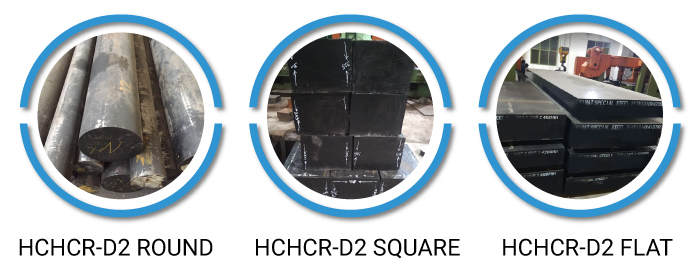
Virat Special Steels is the largest stockiest and supplier of HCHCR D2 Steel in flat, square and round bar. We provide steel in all sizes as your requirements. HCHCR D2 die steel is available in flat, square and round shape. Consult our team who will assist you for HCHCR D2 steel query.


hchcr-d2-steel


Steel Properties

HCHCR-D2 steel is Cold Work Steel with High Carbon High Chromium contents. The Quality with high
wear resistant and toughness properties due to Vanadium addition of 0.90% . Normally it supply condition
is an Annealed and will offer hardness to reach 57-59 HRC. It can be machinable in the annealed
condition. D2 is the superior steels than D3 due to high alloys properties.


Mechanical Properties:


Impact Toughness 77 J/cm2
Hardness 62-63 HRC
Poisson’s Ratio 0.27-0.30
Modulus of elasticity 190-210 GPa


Physical Properties

The physical properties can vary slightly depending on the specific composition and heat treatment of the D2/ DIN 2379/ AISI D2 steel. Its always recommended to refer to the manufacturer’s specifications for precise information.


Coefficient of thermal expansionat °C 20-100 20-200 20-300 20-400
10-6 m/(m*K) 10.6 11.5 11.8 12.3


Thermal Conductivity at °C 20 350 700
W/(m*K) 16.7 20.5 24.2


Heat Treatment & Processes:

Heat Treatment:

The heat treatment Process includes parameters like temperatures, the rate of heating, cooling, soaking time ,the type of furnace, quenching medium, and workpiece transfer facilities.


Hardening:

Allow the D2/ DIN 2379/ AISI D2 tool steel to soak at 750-800°C after preheating it. The tools are then heated to 1000-1040°C for air cooling and 980°C for oil quenching. Soak for thirty minutes per 25mm of the ruling part at the temperature, then cool or quench as needed. When heating for hardening, it is critical not to surpass 1040°C.


Tempering:

Tempering of D2/ DIN 2379/ AISI D2 tool steel should be done with the least possible delay after hardening, preferably when the tools still hand warm. Double tempering is recommended. Heat slowly and uniformly. When the D2/ DIN 2379/ AISI D2 has reached the desired temperature, soak for at least one hour per 25mm of section. The second tempering should be a repetition of the first.


Stress Relieving:

The Stress relief must be done after rough machining. To stress relief, heat the component to approx. 600-650°C in the case of D2/ DIN 2379/ AISI D2 steel. Then it should be Soaked well and cooled in the furnace or in the air.


Normalizing:

D2/ DIN 2379/ AISI D2 steel normalizing process should be avoided because there are chances of distortion due to stress with faster cooling .


Annealing:

It is necessary to heat gently and consistently to 900°C for the annealing of D2/ DIN 2379/ AISI D2 steel. Then it must soak for three to four hours before cooling in the furnace till room temperature. Reheat to 800–1040°C, then soak for another three–four hours. Allow the furnace to drop to room temperature.


Welding:

The metal should always be welded in the annealed or hardened condition always. Hence, it should be used with lowest possible weld current, Peen each weld after completion, ensure parts are clean. Avoid excess joint restraints.


Soft annealing °C Cooling Hardness HB
840 – 870 Furnace max. 250


Stress-relief annealing °C Cooling
approx. 660-710 Furnace


Hardening °C Quenching Hardness after quenching HRC
1000-1050 Air, oil or saltbath, 500-550 °C 63


Tempering °C after quenching 100 200 300 400 500 525 550 600
HRC 64 61.5 58.5 58.5 59 60 57 50

Application

HCHCR D2 tool steel applicable for cold stamping or forming dies, cold forming rolls, Chipper knives, Punches, slitters, shear blades, tools, tyre shredders, trimming, cutting Threading Dies , stamping tools Etc.


D2 Tool Steel – Frequently Asked Questions

What does HcHCr stand for, and what is D2?

HcHCr stands for High-Carbon, High-Chromium — the Indian and Asian market name for AISI D2, a cold-work tool steel widely used for its outstanding wear resistance and dimensional stability during heat treatment.

What is the chemical composition of D2?

D2 contains 1.40–1.60% Carbon, 11.00–13.00% Chromium, 0.70–1.20% Molybdenum, 0.50–1.10% Vanadium, 0.10–0.60% Manganese, and 0.10–0.60% Silicon. The high carbon and chromium contents create large volumes of hard carbides responsible for its exceptional abrasion resistance.

What role does the high chromium content play in D2?

Chromium forms hard carbides that give D2 its wear resistance, provides mild corrosion resistance (semi-stainless), and enables air hardening — which improves dimensional stability during heat treatment.

What are the key mechanical properties of D2?

In the annealed condition D2 reaches 217–255 HB. After hardening it achieves 58–62 HRC with a tensile strength of approximately 1900 MPa and a compressive strength exceeding 2700 MPa. Density is 7.70 g/cm³.

How good is the wear resistance of D2 compared to other tool steels?

D2 is the benchmark for cold-work abrasion resistance. A2 offers roughly half the wear resistance of D2, while O1 is around 30%. H13 is lower still, as it is designed for hot-work applications. PM grades like CPM D2 exceed standard D2 due to finer carbide distribution.

Does D2 have corrosion resistance?

D2 offers mild corrosion resistance and is sometimes called semi-stainless, but it will rust if exposed to moisture. Always clean, dry, and oil D2 tools during storage. For aggressive corrosion environments, choose 440C or a powder metallurgy stainless grade instead.

How dimensionally stable is D2 during heat treatment?

D2 is air-hardening and shows minimal distortion, typically 0.05–0.08% expansion. This predictable behaviour makes it ideal for precision blanking dies, gauges, and close-tolerance tooling.

What is the recommended hardening temperature for D2?

D2 is austenitized at 1010–1040 °C (1850–1900 °F). Lower temperatures in this range give better toughness (~58–60 HRC), while higher temperatures give maximum hardness (~61–62 HRC). Vacuum or controlled-atmosphere furnaces are strongly recommended to prevent decarburization.

How is D2 quenched after hardening?

D2 is air-hardening. Still air is sufficient for sections up to 75 mm; forced air or fan cooling is used for larger sections up to 150 mm. Pressurized gas in a vacuum furnace gives the best dimensional control for large or complex tooling. Temper immediately once the part cools to 50–70 °C — never allow it to reach room temperature first.

What are the main applications of D2?

D2 is widely used for blanking and piercing dies, drawing dies, forming tools, circular slitting knives, shear blades, precision gauges, powder compaction dies, and woodworking knives. Any cold-work application where abrasion resistance is the primary requirement is a strong candidate for D2.

Can D2 be used for plastic injection molds?

D2 is suitable for wear plates and inserts where abrasive plastics such as glass-filled or mineral-filled resins are processed. It is not recommended for high-polish molds or corrosive resins — for those applications use S136, 1.2083, or 420SS.

Can D2 be welded?

D2 is very difficult to weld due to its high carbon and chromium content. It should only be attempted for die repair by experienced welders. Preheat to 300–400 °C, use a matching filler rod, maintain interpass temperature above 260 °C, and temper immediately after welding before the part cools to room temperature. Failure to do so almost always results in cracking.

Is D2 the same as 1.2379 in the European standard?

Yes. D2 (AISI/SAE), HcHCr (India), 1.2379 / X155CrVMo12-1 (DIN/EN), SKD11 (JIS), BD2 (BS), and Kh12MF (GOST) are all equivalent designations. Minor compositional differences exist between standards, so always verify the chemistry against your specification before substituting one for another.


Industries We Serve

D2 Tool Steel is a high carbon, high chromium grade that offers excellent wear resistance, toughness and dimensional stability and is a popular choice in a wide range of industries. It is extensively used in automotive tooling, precision die making, metal stamping, plastic mold making and industrial cutting tools where long service life and dependable performance are of utmost importance. D2 Tool Steel is used by manufacturers to make high-precision dies, punches, shear blades, gauges, and machine parts that can stand up to harsh operating conditions. Virat Special Steels’ D2 Tool Steel, with its consistent performance, superior durability and cost-effective manufacturing solutions, is the ideal choice for industries to achieve precision, productivity and long-lasting results..

View Industries We Serve →


Get in Touch

Have a specific requirement or need a quote for D2 Steel? Reach out to our team directly — call us at +91-98140 21775 or email info@viratsteels.com


Addition to other Grades:

HCHCR-D2 Steel , HCHCR-D3 Steel , P20+Ni Steel , P20 Steel , DB6 Steel , H13 Steel, H11 Steel, H21 Steel, H10 Steel, H12 Steel, M2 Steel, M35 Steel, M42 Steel, T1 Steel, DIN 2379 Steel, DIN 2080 Steel, DIN 2738 Steel, DIN 2311 Steel, DIN 2714 Steel, DIN 2344 Steel , DIN 2343 Steel, DIN 2581 Steel, DIN 2365 Steel, DIN 2606 Steel, DIN 3343 Steel, DIN 3243 Steel, DIN 3247 Steel, DIN 3355 Steel AISI D2 Steel, AISI D3 Steel, AISI P20+Ni Steel, AISI P20 Steel, AISI L6 Steel , AISI H13 Steel, AISI H11 Steel, AISI H21 Steel, AISI H10 Steel, AISI H12 Steel, AISI M2 Steel, AISI M35 Steel, AISI M42 Steel , AISI T1 Steel


We Provide our Special Steels in All Major Cities India.

Agra, Alwar,Ambala, Anand, Bhiwadi, Dehradun, Ghaziabad, Haridwar, Rudrapur, Delhi, Faridabad, Kanpur, Noida, Gurgaon, Manesar, Kundali ,  Chandigarh,  Waluj , Vadodara, Pimpri – Chinchwad, Rajkot, Jaipur, Ahmedabad, Pithampur,  Surat,  Amravati, Vadodara, Indore,  Bhopal, Ranchi, Jamshedpur, Howrah, Kolkata, Pune, Thane, Nashik, Mumbai, Navi Mumbai, Nagpur,  Ambattur, Bangalore, Belgaum, Chittoor, Dindigul, Hyderabad,  Ernakulam,  Chennai, Secunderabad, Visakhapatnam, Coimbatore, Mysore, Nellore, Kochi,  Thiruvananthapuram, Trivandrum, Vijayawada, Guntur, Tirupati, Nazarathpet, Kakinada, Kurnool and many more..

HCHCR-D3 Steel

Grade Brief:

Virat Special Steels is the largest Supplier & Stockiest of HCHCR-D3 Steel in India.
D3 Steel Having 12 % ledeburitic chromium tool steel with great wears resistance . Basically utilized as cutting tools for sheets up to 4 mm thickness, trimming dies, blanking dies for paper and plastics, shear cutting edges and rotational shear edges for sheet thicknesses up to 2 mm.


Consult our Gurugram office for further assistance.
Meanwhile for more on Virat Special Steels;
Email Us: info@viratsteels.com.
Contact them by mobile numbers 98140 – 21775, 99991 – 24971 to 79.

Follow on LinkedIn


Mode of Supply

Virat Special Steels is the largest stockiest and supplier of HCHCR D3 Steel in flat, square and round bar. We provide steel in all sizes as your requirements. HCHCR D3 die steel is available in flat, square and round shape. Consult our team who will assist you for HCHCR D3 steel query.


hchcr-d3-steel


Steel Properties

D3 Steel having properties of High Carbon 2% and High chromium 12 % tool steel with high wear resistance.

Its supply condition is normally annealed to easy machining which recommended hardness is 57-58
HRC after making the dies & tools.


Mechanical Properties:


Impact Toughness 28 J/cm2
Hardness 58-64 HRC
Poisson’s Ratio 0.27-0.30
Modulus of elasticity 190-210 GPa


Physical Properties

The physical properties can vary slightly depending on the specific composition and heat treatment of the D3 steel. Its always recommended to refer to the manufacturer’s specifications for precise information.


Coefficient of thermal expansionat °C 20-100 20-200 20-300 20-400 20-500 20-600 20-700
10-6 m/(m*K) 10.7 11.6 12.3 12.6 12.9 13.2 13.3


Thermal Conductivity at °C 20 350 700
W/(m*K) 16.6 20.5 24.3


Heat Treatment & Processes:

Heat Treatment

Heat treatment Process includes the parameters like temperatures, the rate of heating, cooling, soaking time ,the type of furnace, quenching medium, and workpiece transfer facilities.


Forging:

D3/ DIN 2080 / AISI D3 should be pre-heated at 900-950°C, then increase to 1050-1100°C. Soak until evenly warm. At high temperatures, D3/ DIN 2080 / AISI D3 tool steel becomes quite hard. As a result, the initial hammer blows must be mild, and the temperature must not go below 1020°C until the metal begins to flow. The final forging temperature should not be less than 900°C.


Stress Relieving:

The Stress relieving must be done after rough machining. To stress relief, heat the component to approx 600-650°C in the case of D3/ DIN 2080 / AISI D3 steel. Then it should be Soaked well and cool in the furnace or in the air.


Normalizing:

The hardness after normalization is 55 HRC. The specimen gets tougher after normalizing than after annealing. This is because a higher number of undissolved carbide particles develop, causing the specimen to become brittle.


Annealing:

It is necessary to heat gently and consistently to 900°C for the annealing of D3/ DIN 2080 / AISI D3 steel. Then it must be soaked for three to four hours before cooling in the furnace till room temperature. Reheat to 800–1040°C, then soak for another three–four hours. Allow the furnace to drop to room temperature.


Welding:

D3/ DIN 2080 / AISI D3 tool steel Welding process should be avoided, if possible Due to the high risk of crack formation welding. However when welding is essential, the following guides must be followed:
– Welding of soft annealed D3/ DIN 2080 / AISI D3 tool steel (Preheat to 300 – 500°C, Weld at 300-500°C, Immediately stress relieve) Electrode: Cr-Mo alloy electrode for welding structural steel.
– Welding in connection with hardening of soft annealed D3/ DIN 2080 / AISI D3 tool steel.(Heat to austenitizing temperature, Cool to approx. 500°C, Weld at approx. 500°C, Cool to approx. 100°C in the same way as at normal hardening, then temper to desired hardness). Double tempering will reduce the risk of crack formation.
Electrode: Hard-facing electrode.)
– Repair welding of D3/ DIN 2080 / AISI D3 tool steel is hardened and tempered in condition.(Preheat to the tempering temperature (min. 200°C) previously used, Weld at tempering temperature, Heat immediately to tempering temperature, but max. 300°C. Soaking time 3 hours, Cool in the air to approx. 80°C, Heat to tempering temperature. Soaking time 2 hours.) Electrode: Hard-facing electrode.


Soft annealing °C Cooling Hardness HB
810 – 850 Furnace max. 250


Stress-relief annealing °C Cooling
approx. 670-720 Furnace


Hardening °C Quenching Hardness after quenching HRC
940 – 970 Oil 64.5
950-980 Air (up to 30 mm thickness) 64.5


Tempering °C after Quenching 100 200 300 400 500 600
HRC 63.5 61.5 58 57.5 55 47


Application

HCHCR D3 is used in cold Dies & tooling application that required the achievement of high degree of accuracy in
hardening & tempering, such as dies drawing, forming cold rolls, powder metal tooling and blanking and
trimming dies, blanking dies for paper and plastics, shear blades , cold die punches , Ejector pins etc.


Addition to other Grades:

HCHCR-D2 Steel , HCHCR-D3 Steel , P20+Ni Steel , P20 Steel , DB6 Steel , H13 Steel, H11 Steel, H21 Steel, H10 Steel, H12 Steel, M2 Steel, M35 Steel, M42 Steel, T1 Steel, DIN 2379 Steel, DIN 2080 Steel, DIN 2738 Steel, DIN 2311 Steel, DIN 2714 Steel, DIN 2344 Steel , DIN 2343 Steel, DIN 2581 Steel, DIN 2365 Steel, DIN 2606 Steel, DIN 3343 Steel, DIN 3243 Steel, DIN 3247 Steel, DIN 3355 Steel AISI D2 Steel, AISI D3 Steel, AISI P20+Ni Steel, AISI P20 Steel, AISI L6 Steel , AISI H13 Steel, AISI H11 Steel, AISI H21 Steel, AISI H10 Steel, AISI H12 Steel, AISI M2 Steel, AISI M35 Steel, AISI M42 Steel , AISI T1 Steel


Our Global Presence:

India, Nepal, Dubai, Thailand, Vietnam, Saudi Arabia, United Arab Emirates , Qatar, Kuwait, Iran, Turkey, Portugal, Spain, Poland, UK, USA, Canada, Brazil, Mexico, Belarus, Australia, New Zealand and many more..


We Provide our Special Steels in All Major Cities India.

Agra, Alwar,Ambala, Anand, Bhiwadi, Dehradun, Ghaziabad, Haridwar, Rudrapur, Delhi, Faridabad, Kanpur, Noida, Gurgaon, Manesar, Kundali ,  Chandigarh,  Waluj , Vadodara, Pimpri – Chinchwad, Rajkot, Jaipur, Ahmedabad, Pithampur,  Surat,  Amravati, Vadodara, Indore,  Bhopal, Ranchi, Jamshedpur, Howrah, Kolkata, Pune, Thane, Nashik, Mumbai, Navi Mumbai, Nagpur,  Ambattur, Bangalore, Belgaum, Chittoor, Dindigul, Hyderabad,  Ernakulam,  Chennai, Secunderabad, Visakhapatnam, Coimbatore, Mysore, Nellore, Kochi,  Thiruvananthapuram, Trivandrum, Vijayawada, Guntur, Tirupati, Nazarathpet, Kakinada, Kurnool and many more..
M35 Steel

Grade Brief:

Virat Special Steels is the leading Supplier & Stockiest of M35 Steel in India.
M35 is cobalt content material in these high-performance excessive-speed steel results in high pink hardness and tempering resistance. As a final result, this grade is primarily suitable for conditions involving thermal stresses and discontinuous cutting.
This grade is typically used as heavy-duty milling cutters of every kind, particularly stressed twist drills and taps, profile knives, machining of high-strength substances, broaches


A general-purpose high-speed steel of the molybdenum type, M35/DIN 3243/AISI M35 steel has balanced toughness, wear-resistance, and red hardness characteristics. This grade is frequently used in cold work punches, dies, and high-speed, light-cutting applications. Due to its better qualities, including its improved bending strength, toughness, and thermo-plasticity, all of which are 50% higher than T1, M35 High Speed Steel is by far the most widely used high-speed steel to replace T1 in most applications. Group M steels make up over 95% of the high-speed steels produced in the US. Except for M6, all varieties of steel from M1 through M10 contain tungsten, and none of these steels contain cobalt. Tools constructed of this type of steel can be coated with titanium nitride, titanium carbide, and several other materials using a physical vapor deposition technique to increase their functionality and durability.


Consult our Gurugram office for further assistance.
Meanwhile for more on Virat Special Steels;
Email Us: info@viratsteels.com.
Contact them by mobile numbers 98140 – 21775, 99991 – 24971 to 79.

Follow on LinkedIn


Mode of Supply

Virat Special Steels is the largest stockiest and supplier of M35 Steel in flat, square and round bar. We provide steel in all sizes as your requirements. M35 die steel is available in flat, square and round shape. Consult our team who will assist you for M35 steel query.


m35-steel.jpg


Steel Properties

The cobalt content in this high-performance high-speed steel results in high red hardness and tempering resistance. As a consequence, this grade is particularly suitable for conditions involving thermal stresses and discontinuous cutting. Under the name Rapidur 3245, AISI M 35 + S and material number 1.3245, this steel grade is supplied with a higher sulphur content (S = 0.10 %).


Mechanical Properties:


Tensile strength 481 MPa
Yield Strength 419 MPa
Elongation 34 %
Impact Toughness 12 KV/Ku(J)
Hardness 421 HBW
Modulus of elasticity 07 GPa


Heat Treatment & Processes:

Heat treatment:

The form and size of each component, as well as other external elements, will affect the heat treatment process, which includes the kind of furnace, quenching media, workpiece transfer facilities, and the heating temperatures including the rate of heating, cooling, and soaking durations.


Hardening:

Pre-heat the M35/DIN 3243/AISI M35 to 450–500°C and then to 820–870°C in two steps. Heat the material further until the final hardening temperature reaches between 1050 and 1250°C. Harden in a controlled furnace or vacuum for maximum results, or in a salt bath that has been thoroughly rectified.


Quenching:

Quenching mediums are heated oil, pressurized gas, or salt. To attain the necessary characteristics for pressurized gas, a quick quench rate to below 1000°F (538°C) is essential. For oil, quench at 900°F (482°C) or until it becomes black, then cool to 150–125°F (66–51°C) in calm air. Equalise, then cool in calm air to 150-125°F (66-51°C) for salt that is kept at 1000-1100°F (538-593°C).


Tempering:

Temper immediately after quenching in a temperature range of (510-620°C).


Forging:

Pre-heat M35/DIN 3243/AISI M35 to 450–500°C, then immediately raise the temperature to 950–1100°C for forging. Under 950°C, do not forge. After forging, cool very gently.


Stress Relieving:

To reduce the chance of distortion, stress relief is advised to be performed following machining and before hardening. Heat the component to 600–700°C and soak thoroughly for around two hours to reduce tension. Cool the boiler gradually.


Annealing:

After hot working and before re-hardening, M35/DIN 3243/AISI M35 Steel must undergo the annealing process. Heat at a maximum rate of 220°C per hour at 850°C. Always maintain temperature for two hours, or one hour every 25 mm of thickness. The furnace gradually cools. The hardness of the M35 annealed material should be 260 Brinell or less.


Normalizing:

M35/DIN 3243/AISI M35 is provided in an annealed, machineable state. Only when the steel has been hot wrought, forged, or toughened by the toolmaker will re-annealing be required. M35 high-speed steel should be heated to 850°C at a maximum rate of 220°C per hour.


Welding:

Special welding techniques including preheating and filler materials made from base material composition are used. After that , let the components cool gently.


Soft annealing °C Cooling Hardness HB
820 – 860 Furnace max. 269


Stress-relief annealing °C Cooling
630 – 650 Furnace


1st pre-heating °C 2nd and 3rd Hardening °C Quenching Tempering °C Hardness after Teperature HRC
up to approx. 400 in an air-circulating furnace 850 and 1050 1190 – 1230 Saltbath, at least 550 °C Oil ,Air at least twice 540-570 64 – 67


1 For cold-forming tools with a complex geometry, a hardening temperature at the lower end of the quoted range is recommended. The stated hardening temperatures apply to saltbath hardening only. For vacuum hardening, we suggest a reduction of 10 °C to 30 °C.


Application

Heavy-duty milling cutters of all kinds, highly stressed twist drills and taps, profile knives, machining of high-strength materials, broaches. Manufacture of various cutting tools like cutter, broach, end milling cutter. Advanced punching die, screw die, the toughness and complex shape tools, reamer, milling cutter, bunt, punch, etc


Forging-Components

Addition to other Grades:

HCHCR-D2 Steel , HCHCR-D3 Steel , P20+Ni Steel , P20 Steel , DB6 Steel , H13 Steel, H11 Steel, H21 Steel, H10 Steel, H12 Steel, M2 Steel, M35 Steel, M42 Steel, T1 Steel, DIN 2379 Steel, DIN 2080 Steel, DIN 2738 Steel, DIN 2311 Steel, DIN 2714 Steel, DIN 2344 Steel , DIN 2343 Steel, DIN 2581 Steel, DIN 2365 Steel, DIN 2606 Steel, DIN 3343 Steel, DIN 3243 Steel, DIN 3247 Steel, DIN 3355 Steel AISI D2 Steel, AISI D3 Steel, AISI P20+Ni Steel, AISI P20 Steel, AISI L6 Steel , AISI H13 Steel, AISI H11 Steel, AISI H21 Steel, AISI H10 Steel, AISI H12 Steel, AISI M2 Steel, AISI M35 Steel, AISI M42 Steel , AISI T1 Steel


Our Global Presence:

India, Nepal, Dubai, Thailand, Vietnam, Saudi Arabia, United Arab Emirates , Qatar, Kuwait, Iran, Turkey, Portugal, Spain, Poland, UK, USA, Canada, Brazil, Mexico, Belarus, Australia, New Zealand and many more..


We Provide our Special Steels in All Major Cities India.

Agra, Alwar,Ambala, Anand, Bhiwadi, Dehradun, Ghaziabad, Haridwar, Rudrapur, Delhi, Faridabad, Kanpur, Noida, Gurgaon, Manesar, Kundali ,  Chandigarh,  Waluj , Vadodara, Pimpri – Chinchwad, Rajkot, Jaipur, Ahmedabad, Pithampur,  Surat,  Amravati, Vadodara, Indore,  Bhopal, Ranchi, Jamshedpur, Howrah, Kolkata, Pune, Thane, Nashik, Mumbai, Navi Mumbai, Nagpur,  Ambattur, Bangalore, Belgaum, Chittoor, Dindigul, Hyderabad,  Ernakulam,  Chennai, Secunderabad, Visakhapatnam, Coimbatore, Mysore, Nellore, Kochi,  Thiruvananthapuram, Trivandrum, Vijayawada, Guntur, Tirupati, Nazarathpet, Kakinada, Kurnool and many more..