Virat Steels | India’s Leading Tool and Die Steel Supplier
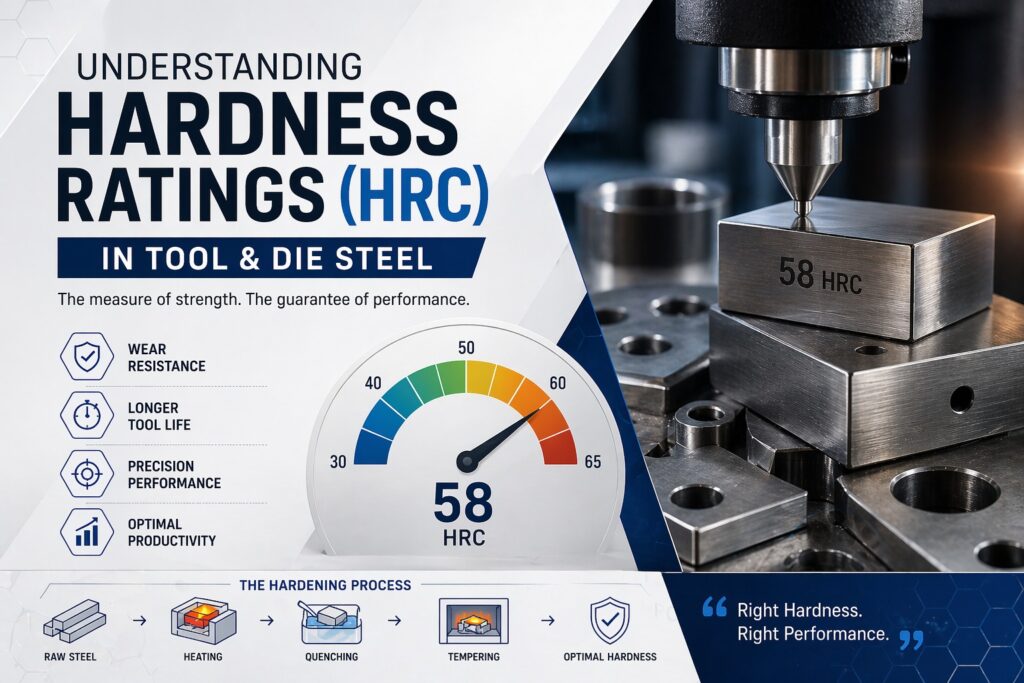
If you’ve ever looked at a tool steel datasheet and wondered what “58 HRC” means and why it matters for your die or mould. Hardness is one of the most critical properties in tool and die steel selection. Get it right, and your tooling performs reliably for thousands of production cycles. Get it wrong, and you’re facing premature wear, unexpected cracking, or both. This complete blog explains what is the Rockwell C scale means, maps HRC ranges to every major tool steel grade, and shows you exactly how to choose the right hardness for your application.
What is Hardness in Steel and Why Does It Matter?
In simple terms, hardness is a material’s ability to resist dents, scratches, or permanent deformation under pressure.
For tool and die steel, hardness is one of the most important properties because it affects:
- Wear resistance – resists abrasion and surface wear
- Edge retention – keeps cutting tools sharper for longer
- Compressive strength – withstands heavy forming pressure
- Dimensional stability – maintains shape and accuracy during production
However, hardness always comes with a trade-off: toughness.
As hardness increases, the steel can become more brittle and prone to cracking under impact.
So, the right steel grade and hardness level should provide the best balance of wear resistance and toughness for the application.
What is the Rockwell Hardness Test?
The Rockwell hardness test is the most widely used hardness measurement method in the tool steel industry.
The Rockwell hardness test checks how hard a material is by measuring how deep a diamond cone goes into its surface.
It works in 3 simple steps:
- Minor load applied – A small force (10 kgf) is applied first to set the starting point and remove surface unevenness.
- Major load applied – A bigger force (150 kgf for HRC) pushes the diamond into the material.
- Load removed – The big force is removed, and the machine measures how deep the mark remains.
Result:
- Less depth = harder material = higher HRC
- More depth = softer material = lower HRC
Understanding HRC -The Rockwell C Scale
HRC stands for Hardness Rockwell C -meaning the result was obtained using the Rockwell C scale. It is the standard unit used to express the hardness of virtually all tool and die steels.
The HRC scale for tool steels runs approximately from 20 HRC(soft, annealed or pre-hardened low-alloy steel) to 68 HRC (the upper limit of conventional hardened tool steel). Here is how the HRC range maps to practical tool steel conditions:
| HRC Range | Condition / Category | In Practice |
| 20-35HRC | Soft / pre-hardened | Easily machined; P20 mould steel supply condition |
| 36-44 HRC | Medium Hardness | Good toughness; forging dies for heavy impact |
| 45-52 HRC | Hard | Balanced wear resistance and toughness; H13 die casting dies |
| 53-60 HRC | Very Hard | High wear resistance; D2 cold work dies, punches |
| 61-66 HRC | Extremely Hard | Maximum wear resistance; M2, M42 high-speed steel cutting tools |
| Above 66 HRC | Ultra Hard | Extremely brittle; not typical for standard die steels |
HRC vs HRB vs HRA — Which Scale Applies to Tool Steel?
| HRC | HRB | HRA |
| Indenter: Diamond cone | Indenter: 1/16″ steel ball | Indenter: Diamond cone |
| Major load: 150 kgf | Major load: 100 kgf | Major load: 60 kgf |
| Range: Approx 20–70 HRC | Range: Approx 0–100 HRB | Range: for very hard materials |
| Used For: All hardened and heat-treated tool steels, die steels, high-speed steels, and hardened alloy steels | Used For: Softer steels (mild steel, annealed low-alloy steel), copper alloys, aluminium alloys | Used For: Cemented carbides, case-hardened surfaces, thin hardened layers |
You cannot directly compare numbers from different Rockwell scales. 60 HRC and 60 HRB are not equivalent, they refer to completely different hardness levels. Always confirm which scale a hardness value is expressed in before comparing materials.
HRC vs Brinell (HB) vs Vickers (HV): Approximate conversion table for tool steel
While HRC is the standard for tool steel, you will also encounter Brinell (HB or HBW) and Vickers (HV) hardness values — particularly on material certificates from European suppliers who use DIN specifications.
| HRC | HB (Brinell) | HV (Vickers) | Approx. Tensile Strength |
| 20 | 226 | 238 | ~780 MPa |
| 25 | 253 | 266 | ~870 MPa |
| 30 | 286 | 302 | ~995 MPa |
| 35 | 327 | 345 | ~1140 MPa |
| 40 | 371 | 392 | ~1310 MPa |
| 45 | 421 | 446 | ~1500 MPa |
| 48 | 455 | 481 | ~1630 MPa |
| 50 | 481 | 509 | ~1720 MPa |
| 52 | 512 | 544 | ~1820 MPa |
| 55 | 560 | 595 | ~1980 MPa |
| 58 | 615 | 655 | ~2160 MPa |
| 60 | 654 | 697 | ~2280 MPa |
| 62 | 746 | 746 | ~2400 MPa |
*Note: These are approximate conversions. For precise engineering calculations, always use the original test method. Conversion between hardness scales involves empirical estimates, not exact equivalences. *
HRC Ranges for Common Applications — Quick Reference
If you are selecting tool steel hardness based on the application & the grade, here is a practical quick-reference guide:
| Application | Recommended HRC | Recommended Grade |
| Aluminium die inserts | 44–48 HRC | H13 tool steel / DIN 1.2344 ESR |
| Aluminium extrusion dies | 48–52 HRC | H13 tool steel / DIN 1.2344 |
| Hot forging dies (heavy hammers) | 40–45 HRC | H13 or H11 |
| Hot forging dies (mechanical press) | 46–50 HRC | H13 |
| Cold stamping and blanking dies | 58–62 HRC | D2 tool steel / DIN 1.2379 |
| Cold forming and bending dies | 56–60 HRC | D2 or A2 |
| Plastic injection mould cavities | 48–54 HRC | H13 or P20+Ni |
| Plastic injection mould bases | 28–32 HRC | P20 / DIN 1.2311 |
| Drill bits and taps | 62–65 HRC | M2 / DIN 3343 |
| Cutting and slitting knives | 58–62 HRC | D2 or M2 |
| Punches (light impact) | 58–62 HRC | D2 |
| Punches (heavy impact) | 52–58 HRC | H13 |
| Gauges and measuring tools | 58–64 HRC | D2 or EN31 |
What Happens if HRC is Too High or Too Low?
1. If HRC is too high
The die becomes too hard and brittle.
- More chances of cracking or breaking under impact or stress
- In hot work, heat checking (small surface cracks) starts earlier
- Sharp corners and weak areas may fracture suddenly
- Failure can happen without warning
2. If HRC is too low
The die becomes too soft.
- Surface wears out quickly
- Shape and size accuracy reduce over time
- Can deform permanently under heavy pressure
- In die casting, molten metal may stick to the die (soldering)
- In cutting/stamping, edges become dull or chip fast
- Failure is gradual, but die life becomes much shorter
So, the correct HRC should balance hardness and toughness for the application.
What to check on the MTC
1. Verify the hardness is within the specification for the supply condition. H13 in annealed supply should not exceed 229 HBW. Higher values may indicate the material was not properly annealed.
2. Check for uniformity. If multiple hardness readings are reported from different locations in the bar, they should be consistent. Large variation in hardness across a section is a warning sign of segregation or poor annealing.
3. Confirm the test method. Brinell (HBW) and Vickers (HV) hardness values on the certificate are not directly comparable to HRC values you may see on a datasheet — use the conversion table above if comparison is needed.
4. For pre-hardened grades (P20): Verify the HRC range corresponds to 28–32 HRC. Values outside this range may indicate the steel will machine differently than expected or may not meet the performance requirements of the mould design.
Frequently Asked Questions
1. What HRC stands for in steel?
HRC stands for Hardness Rockwell C, a standard hardness scale for hardened tool steels. Higher HRC means harder and more wear-resistant steel.
2. What HRC is H13 tool steel?
H13 is typically hardened to 40–52 HRC depending on use:
- Die casting: 44–48 HRC
- Extrusion/plastic moulds: 48–52 HRC
- Forging dies: 40–44 HRC
3. What is the HRC of D2 steel?
D2 is usually hardened to 55–62 HRC for stamping and blanking applications.
4. What is the difference between HRC and HB hardness?
HRC uses a diamond cone and measures depth; HB (Brinell) uses a ball indenter and measures impression size.
5. Is higher HRC always better for dies?
No. Higher HRC improves wear resistance but reduces toughness, increasing crack risk.
6. What HRC should I specify for a plastic injection mould?
- P20: 28–32 HRC
- H13: 48–52 HRC for longer runs or abrasive materials
7. Can I check tool steel hardness without a lab?
Yes. Use portable Rockwell or Leeb hardness testers for quick on-site checking.
8. What hardness should I specify when ordering H13?
H13 is usually supplied soft-annealed (max 229 HBW) for machining or can be supplied pre-hardened (30–36 HRC) / fully hardened as required.
9. Why do two steels with the same HRC perform differently?
HRC alone doesn’t tell the full story & performance also depends on:
- Chemical composition
- Heat treatment quality
- Grain structure
- Alloying elements
10. What is the HRC of DB6 steel for forging dies?
For forging dies, DB6 is commonly used around 38–42 HRC to balance toughness and wear resistance. It is known for better toughness than H13 in heavy-impact applications.
- Pre-hardened condition: 360–430 BHN (approx. 38–45 HRC)
- Fully hardened / heat-treated: up to 50–55 HRC
- Annealed condition: max 240–255 BHN
Conclusion
At Virat Steels, we help customers across India choose the right tool steel grade, correct HRC, and suitable size/form for die casting, forging, extrusion, and plastic moulding applications backed by stock availability, test certificates, and ultrasonic-tested material.
📞+91 98140-21775 | 🌐www.viratsteels.com | ✉info@viratsteels.com