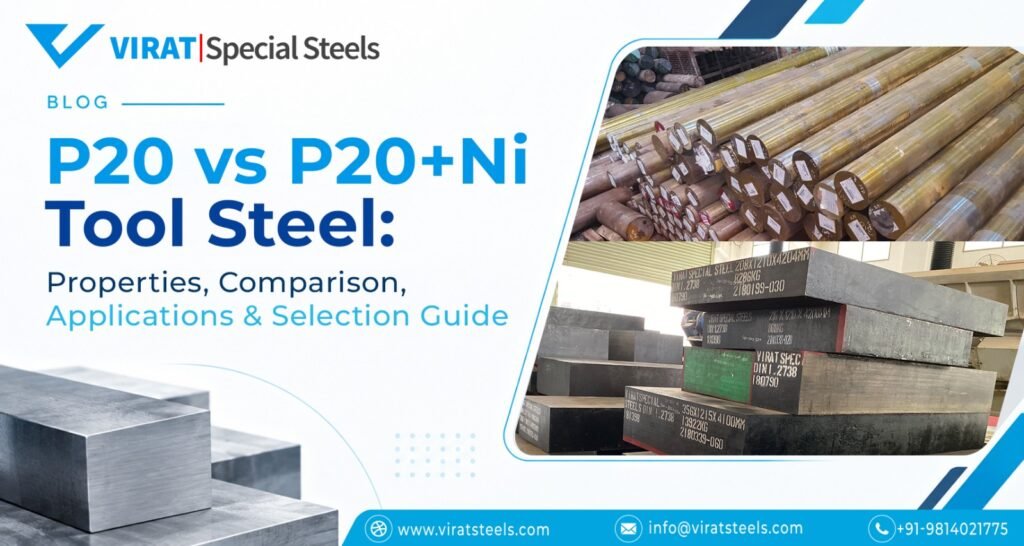
In the plastic mould industry, selecting the right material plays a crucial role in determining tool life, surface finish, and production efficiency. Two of the most used mould steels are P20 Vs P20+Ni (Nickel Alloyed P20 Steel).
But which one is better for your application?
In this blog, we compare P20 vs P20+Ni tool steel to help manufacturers make the right decision.
What is P20 Tool Steel?
P20 is a pre-hardened plastic mould steel widely used in the manufacturing of:
- Plastic injection moulds
- Die casting dies
- Automotive components
- Mold bases
Key Properties of P20 Steel
- Hardness: 280–320 BHN
- Good machinability
- Moderate toughness
- Cost-effective solution
- Suitable for medium production runs
What is P20+Ni Tool Steel?
P20+Ni is an enhanced version of P20 steel with Nickel (Ni) added, improving its performance significantly.
Key Properties of P20+Ni Steel
- Improved toughness
- Better hardness uniformity
- Superior polishability
- Enhanced core strength
- Ideal for high-quality moulds
P20 vs P20+Ni Tool Steel : Key Differences
| Property | P20 Steel | P20+Ni Steel |
| Toughness | Moderate | High |
| Hardness Uniformity | Standard | Excellent |
| Polishability | Good | Superior (Mirror Finish) |
| Core Strength | Average | Strong |
| Cost | Lower | Slightly Higher |
| Best Use | General moulds | High precision & glossy moulds |
Why Choose P20+Ni for Plastic Moulds?
If your application requires:
✔ High surface finish (mirror polish)
✔ Large mould sizes
✔ Better durability and longer tool life
✔ Uniform hardness across thick sections
Then P20+Ni steel is the better choice.
Applications of P20 & P20+Ni Tool Steel
Both grades are widely used in:
- Plastic injection moulds
- Blow moulds
- Die casting dies
- Automotive plastic components
- Consumer product moulds
Result:
Why Choose Virat Special Steels?
At Virat Special Steels, we provide premium quality P20 and P20+Ni tool steel with:
- Large ready stock
- Assured material quality
- Custom sizes available
- Competitive pricing
- Fast delivery across India
We are a trusted tool and die steel supplier in India, serving Pan India industries including key industrial hubs such as Pune, Nashik, Ahmedabad, Rajkot, Ludhiana, Faridabad, Ghaziabad, Gurgaon, and the entire South India region.
Our Supply Network Across India
We supply H13, DB6, H11, H12, H10 and H21 P20 and P20+Ni tool steels across major industrial hubs — Delhi, Gurugram, Faridabad, Noida, Ghaziabad, Jaipur, agra, Ahmedabad, Vadodara, Surat, Rajkot, Mumbai, Pune, Nashik, Indore, Bhopal, Rudrapur , Chennai, Coimbatore, Hyderabad, Kolkata, Jamshedpur, Secunderabad and Nellore — with standard and custom sizes, cut-to-size material, annealed or heat-treated condition, and material test certificates as required.
Conclusion
Both P20 and P20+Ni tool steels have their own advantages, but the right choice depends on your application.
If you’re looking for a reliable P20 / P20+Ni steel supplier in India, Virat Special Steels is your trusted partner.
Contact our team to get more details about available sizes and technical specifications suitable for your applications.
Get a Quote
Looking for reliable H13, DB6 or other hot work tool steel? Virat Special Steels supplies round & flat bars, forged & rolled blocks, ESR/non-ESR blocks and cut-to-size material — complete with MTC, UT testing, spectro testing, custom machining, ready stock and PAN India delivery.
Call: +91-98140 21775 Email: info@viratsteels.com Locations: Gurgaon (Haryana) | Ludhiana (Punjab)
FAQs Frequently Asked Questions
1. What is the difference between P20 and P20+Ni steel?
P20+Ni contains nickel, which improves toughness, polishability, and hardness uniformity compared to standard P20.
2. What is the hardness of P20 steel?
Typically 280–320 BHN in pre-hardened condition.
3. Which steel is better for mirror finish moulds?
P20+Ni steel is preferred due to its superior polishability.
4. Where can I buy P20+Ni tool steel in India?
You can source high-quality P20 and P20+Ni steel from Virat Special Steels.
5. What is the use of P20+Ni steel?
P20+Ni steel is mainly used for plastic injection molds, large molds, automotive molds, blow molds and applications which require good polishability, toughness and uniform hardness.
6. P20+Ni is better than P20?
Large, high quality and precision molds can be better manufactured using P20+Ni because of its nickel alloying that offers a better toughness, hardness uniformity and polishability. Properties of standard P20 are often good enough for general purpose mold applications.
7. What is the hardness of P20+Ni steel?
P20+Ni is usually supplied in the prehardened condition. The actual hardness may vary with grade, manufacturer, section size and condition of supply. Always check material test certificate for indicated hardness.